


What 'Wine & Halva' is ultimately attempting, through humour and friendship, is education. It is trying to make certain lived experiences legible to audiences who might never otherwise encounter them.
'Wine & Halva' is not the usual kind of play that you get to see at Montreal’s well-established theatre institutions. Currently being performed at Teesri Duniya Theatre’s Rangshala studio, it sits at the intersection of east and west, and the unspoken cost of fitting in. The title says it all: 'Wine & Halva' likely don’t go together, and that's precisely the point. But if one is adventurous enough, then the possibilities are endless.
This eclectic piece of theatre begins with a little piece of halva and a cup of coffee offered to you as soon as you enter the thoughtfully curated space; so if you're not already "woke", that hit of caffeine will certainly wake you up for what's in store. For that matter, if you're lucky enough, you may even get a coffee reading before the actual performance begins, which would leave you wondering if you've gotten such immense value for your buck ever before in Montreal.

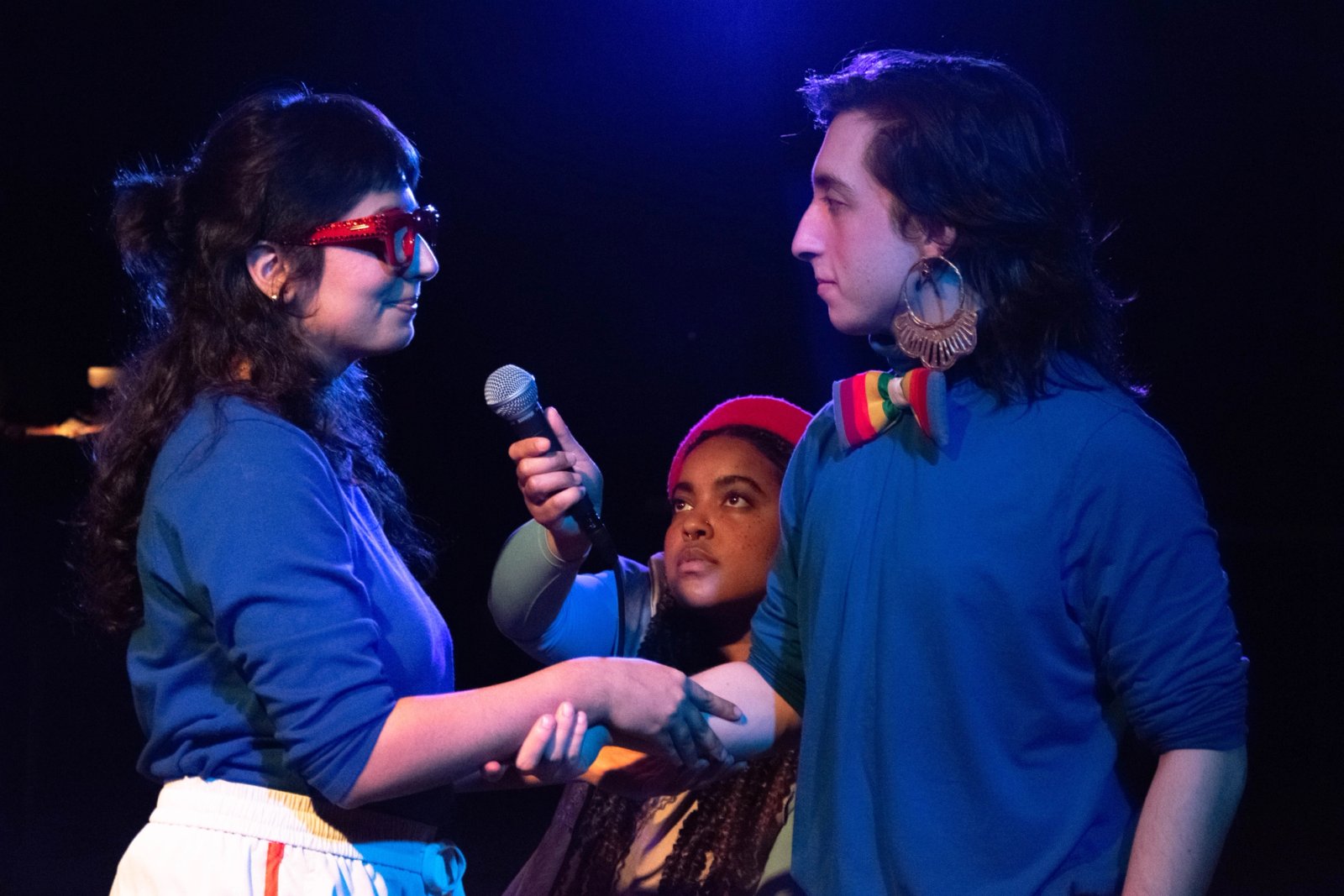
A story of two friends, Derya and Farias, who come from different worlds and lived experiences, 'Wine & Halva' takes you on a journey through the evolution of their friendship from the east to the west and back, as they navigate cultural stereotypes and political tension, and get to know each other deeply in the process. What makes the staging unconventional is that Derya and Farias are not played by a single actor each. Instead, three performers, Banafsheh Hassani, Corbeau Sandoval, and esi callender, share the two characters between them, each slipping in and out of Derya, Farias, and the narrators who stitch the story together. One moment, an actor is Derya; the next, they step back and become a storyteller commenting on the action; and soon after, they embody Farias. The transitions are so seamless, and the performers so committed, that you stop tracking who is playing whom as you get to know the characters better. Eventually, the fluidity almost feels like a statement: that identity was never fixed to begin with.
Right from the beginning, the play dismantles the traditional distance between audience and stage, a choice rooted in the Orta Oyunu, a centuries-old tradition of narrative theatre from West Asia that places performers and audience in a shared circular space. You don’t sit far away watching actors under a spotlight from the darkness. Rather, you are within the story itself: sitting at tables, close enough to hear every silence and every uncomfortable laugh. There is a scene where Derya cooks for Farias, food being her love language and her way of bridging two worlds, when plates were brought to the very table I was sitting at. This particular segment was such a surreal experience watching the protagonists eat and debate right next to me that, for a while, it felt like I wasn’t witnessing a friendship, but rather living one.
the fluidity almost feels like a statement: that identity was never fixed to begin with.
There is another scene where Derya, while studying and living in Farias' hometown in North America, describes to him the quiet frustration of being constantly put into a box because of her background and the assumptions people make before she has even finished a sentence. This moment in the play opens into something much larger. 'Wine & Halva' exposes what mainstream narratives fail to grasp: there is a profound difference between how the words "expat" and "immigrant" are perceived. Move from West to East, and you are an expat: adventurous and cosmopolitan. Move from East to West, and you are an immigrant: a word that is loaded with racism and institutional suspicion. This is not a linguistic accident; it is a colonial inheritance, and one we rarely examine thoroughly. Why can't we simply call everyone migrants? Instead, these archaic labels sort people into hierarchies before they have even unpacked their bags.
Derya, whose name means "Sea," carries that meaning throughout the play: vast and deep but never quite containable within the borders others draw around her. She leaves everything familiar behind with courage, only to discover that North America has already filed her into a category she never chose for herself. Her journey, the nostalgia for language and culture, the exhaustion of constantly negotiating belonging, and the quiet battle of being reduced to a stereotype will resonate with many. Farias, whose name means "Lighthouse," starts the play needing direction as much as he provides it, but his friendship with Derya shifts something in him. Despite being a minority himself in some aspects, he eventually begins to reckon with the privilege of where he comes from, and by the end, he lives up to what his name always promised. A sea needs a lighthouse. Turns out a lighthouse needs the sea too- otherwise, what’s the point of its existence?
Not everyone in that room is there to be challenged. One line captures this perfectly: "Those who do not want to learn cannot be educated."
‘Wine & Halva’ highlights that migration changes people in ways that are often unfamiliar to those who have never had to leave “home”. When people move across cultures, they are constantly evolving and adapting as they negotiate identity and belonging. Meanwhile, people who have only lived within a single cultural framework often experience identity as stable and singular. And perhaps because of that limited exposure, unconscious biases emerge. Stories like this challenge audiences to confront the limitations of their own perspectives and understand better what it means to truly integrate into a society without losing one’s authentic self in the process. But the play is also honest about its own limits. Not everyone in that room is there to be challenged. One line captures this perfectly:
"Those who do not want to learn cannot be educated."
The whole production pivots on that sentence. Because what 'Wine & Halva' is ultimately attempting, through humour and friendship, is education. It is trying to make certain lived experiences legible to audiences who might never otherwise encounter them. However, if people consciously choose not to engage with stories outside their own realities, what else can be done?
Such theatre productions have been working hard for decades to champion voices that mainstream Canadian theatre too often sidelines, and yet stories about migrant realities and displacement still have to fight harder for visibility and funding.
But perhaps the purpose of this play is simply to make people who already live these experiences feel seen. 'Wine & Halva' is meaningful theatre that does not apologize for taking up space. Go see it. And if you get the coffee reading, perhaps a more “woke” future awaits you.
Wine & Halva runs May 9–23, 2026, at Rangshala, Cité-des-Hospitalières, 251 av. des Pins Ouest. Written by Deniz Başar. Directed by Art Babayants. Performed by Corbeau Sandoval, Banafsheh Hassani, and esi callender. Produced by Sort Of Productions and Art Babayants, in association with Postmarginal, and in collaboration with Teesri Duniya Theatre.
 About Ankush
Ankush Lamba is an Indian-Canadian writer, poet, and columnist based in Montreal. An HEC Montreal MBA graduate working in tech marketing, he explores migration, identity, and belonging. Having travelled to over 50 countries, he brings a global lens to his work. A QWF member, his writing appears in the Montreal Gazette and beyond.
Read moreComments
Be the first to speak into the void.