
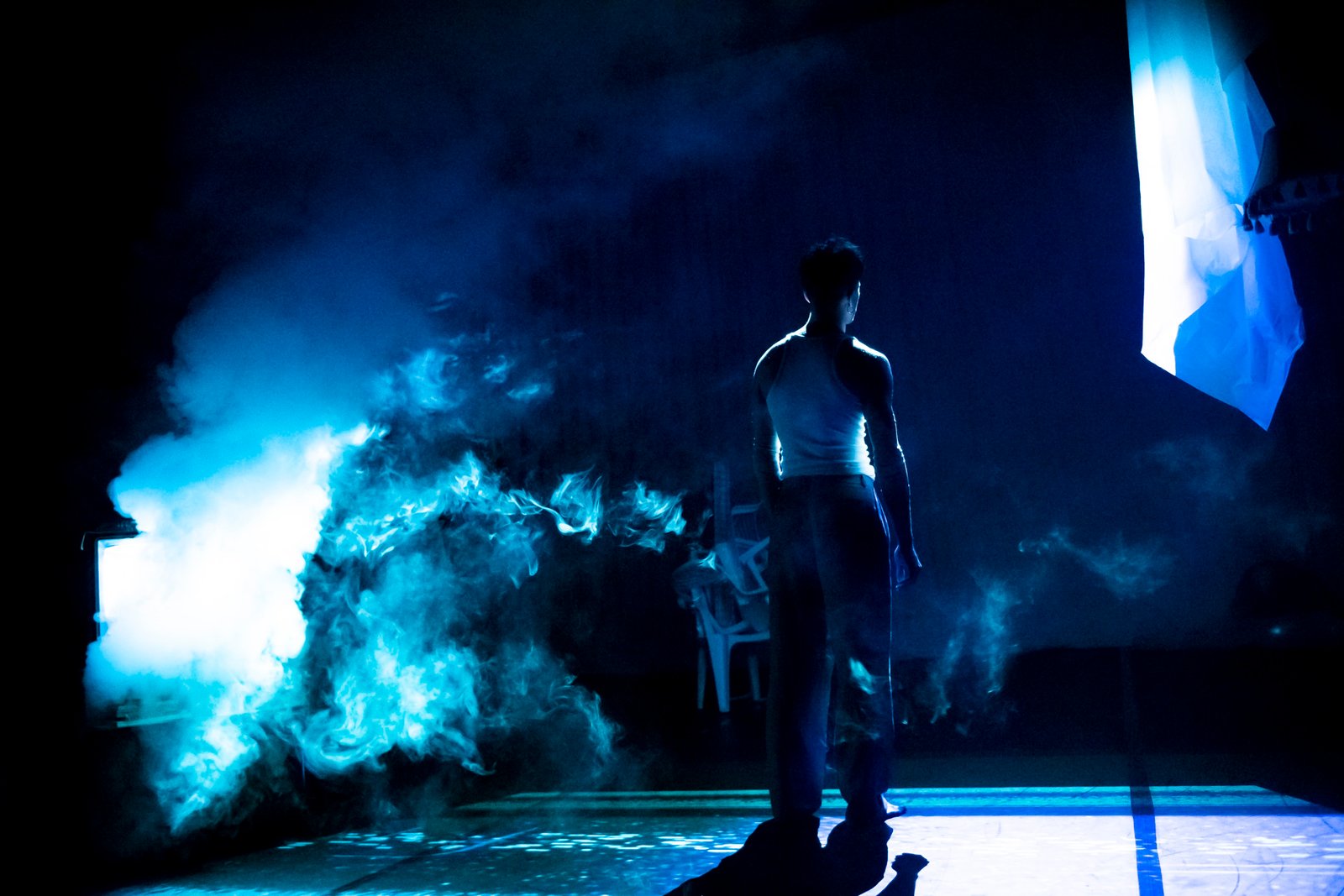
With hypnotic detail, Al Warda attunes its audience to a complex experience of identity and belonging beyond the self, beyond any given moment in time.
“It’s a full house,” the usher says as I walk in. Indeed, Théâtre Aux Écuries is packed on a Thursday evening with Montreal’s young, queer creatives and socialites. There’s no mystery about what has drawn these glittering moths to this quiet corner of Villeray. Flame–dancer, choreographer, and performer extraordinaire–has thrown down on many stages and dancefloors around the city. Tonight, though, he’s serving something quite different, with a side of pumpkin seeds.
The opening act, Spillover by Merlin Matthewson and Nadav Sadlik, is a rushed and clunky clown set. The duo’s antics reach a climax when one of them pisses into a jug, while the other slaps him on the ass–and then promptly hands the jug to an audience member to hold. It gets the audience riled up and giggling, which feels disjointed from the somber act that follows.
When the curtain opens for the main act, we find ourselves in a cozy living room. An old-school television set–the kind with dials and antennae–sits on a table to one side. It's adorned with lace doilies, strewn books and papers, a framed photograph, a crystal decanter filled with a dark liquid. On the other side, facing the TV, is a white Monobloc chair, glowing under the light of a tasseled, bell shaped lampshade. I sense exquisite care in the lighting and scenography by Manon Pocq Saint-Joan and Pénélope Dulude-de Broin, interwoven with the personal effects of Flame’s French-Egyptian heritage.
Walking slowly, Flame enters carrying a bulk bag of pumpkin seeds on one shoulder. He’s barefoot, sporting a sleeveless white tank and a tan jacket with slacks. He takes a seat on the chair, and helps himself to a few seeds. His sullen demeanor projects a masculinity I immediately recognize. You know, the kind of older man who soothes his haunted mind with simple distractions–stars on television, cigarettes, crunchy pumpkin seeds, and a bit (or maybe a lot) of liquor.
With hypnotic detail, Al Warda attunes its audience to a complex experience of identity and belonging beyond the self, beyond any given moment in time. Like Flame, I’m also a third culture kid, meaning we were raised in a different culture than our parents. Third culture kids are sometimes described as citizens of everywhere and nowhere at once. Cultural chameleons who can slip between cultural borders, almost as seamlessly as the estimated billions of Monobloc chairs that have slipped into global circulation since the 1970s.
I’m gripped by an uneasy feeling of kinship to an object that has been described by some as “contextless.” The easily stackable piece of polypropylene furniture is a symbol of both the magic and myth of globalization. It evokes my own domestic memories, just as much as scenes of places to which I do not belong. Using the Monobloc to invoke the paradox of complexity hiding in deceptive simplicity is incredibly clever.
I’m quickly immersed in the uncanny emotional landscape of memory and displacement that Flame and his talented team masterfully begin conjuring. At one point, Flame is standing, gazing at the static on the TV. Suddenly, he collapses. I feel it in my gut when his lanky limbs hit the floor with a crack. He gets up, and immediately falls again, as if losing consciousness. This happens over, and over. So many times that, even assuming knee pads are in place, it feels brutal to witness.
The image jumps from the TV screen to a hanging white curtain hanging at centre stage, as if a spirit has decided to leave one object and possess another. Eventually it turns to static. Someone–maybe the spirit–turns the volume of the static up, and it’s starting to crescendo along with other whirring and electrical sounds–like something is short-circuiting.
Fog fills the air. Lights flicker and flare. The lampshade twirls, and Flame looks dazed as he stumbles around the topsy turvy living room. For a split second, I’m jarred by the sensation that the entire set is literally levitating. We’re being transported elsewhere in time and space.
In this world, ambiguity allows us to more plainly see that which is normally difficult to perceive with the senses.
Eventually, Flame turns his back to a small screen on the far side of the stage, playing what appears to be home videos, which I take as a symbolic gesture. Facing the audience, he begins jogging in place to a fast-paced, percussive beat. He does this for an uncomfortably long time with an expression of serious concentration. Gradually, he begins incorporating subtle shifts in the movement, while maintaining a fixed position. A bit more lateral spring here. A bit more back leg extension there. Each phase of the groove’s evolution is extended in a feat of trance-like endurance. Flame breaks into a glistening sweat, and finally, breaks the spell.
He begins to move more freely around the stage. A smile escapes his lips in this more expressive, sensual mode. In a sequence toward the end, he summons another hypnotic gesture: twirling, drawing on the meditative dance tradition of Sema practiced in Sufism. There’s something beautifully elemental in Flame’s choreography, developed in part at La Serre’s 2025 Radial Residency. Repetition and circling lure us into a comforting space that is always then disrupted, making space for his creative agency.
As the dancing subsides, Flame takes a moment to steady himself before taking a seat–this time on the crooked pile of Monoblocs. Pumpkin seeds rain down next to him.
The gesture references the opening scene, without repeating it. There is something satisfying about this variation on the opening scene, about circling back to it without precisely re-enacting it. He’s not the same man at the end. He also draws our attention to another object with a strange global trajectory, the pumpkin. In Egypt, native varieties of pumpkins have been grown by farmers for generations.
Chameleon or not, traveling and adapting across time and space is, in fact, never seamless. When you look closely, there’s friction. Flame helps us feel the heat by diving headfirst into what he calls the “glitch.” In an Instagram post about the show, Flame writes (translated from French): “Glitch: technical malfunction, transmission error, visual anomaly. When the future, past, and present collide, spacetime contracts and then explodes, revealing a liminal world at the edge of reality.”
In this world, ambiguity allows us to more plainly see that which is normally difficult to perceive with the senses. The commonplace object unrolls before us as a monstrous process, more expansive than our field of vision. As in, a farmer’s labour to feed her community under mounting external pressures. As in, a people’s complex struggle for liberation. As in, the pains through which a dancer goes to conjugate the ancestral rhythms with which his body–collective bodies–are possessed.
The technical aspects of the work were impressively fine-tuned, and complemented the choreography. The sound design by Antoine Racine helped carry viewers into that sacred, liminal space. It shows that this was a team effort.
Al Warda is dense with symbolism and meaning, impressively tucked into a run time of only 40 minutes. Nourishing, just like pumpkin seeds tucked into their little shells, which were served at the theatre’s bar after the show.
Al Warda was performed at Théâtre Aux Écuries as part of OFFTA 2026, On June 3 & 4, 2026. You can find more information about Flame here.
 About Danielle
Danielle is a writer and editor based in Tiohtià:ke.
Read moreComments
No comments yet.
Be the first to speak into the void.