
Read DIS
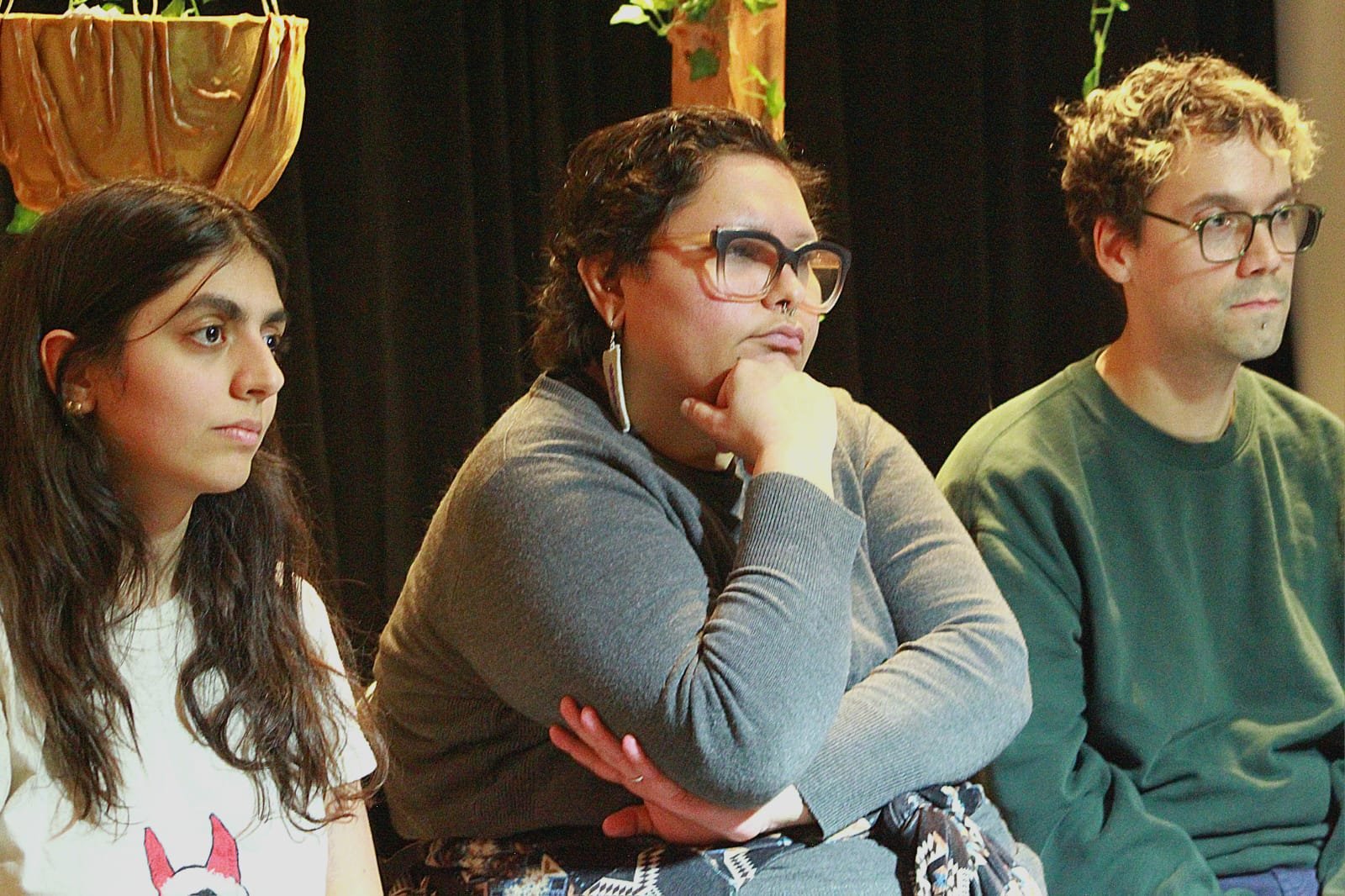
DIS is a theatre criticism hub and training program for anglophone BIPOC artists and writers in Montreal.

30 articles


Park 'N Play: The Young Desire to be Free


Migratory Birds: Struggle, Loss, Hope
We are not just watching actors; we are seeing three people who know what it is like to leave a country behind, the struggle of navigating and adapting to cultural differences, the feeling of nostalgia, and the hope for belonging.


Echoes in the Street: Dizzying Reverberance
Echoes in the Street attempts to weave together a history of student protests in Montréal, beginning with an all-too-brief history of the student protests of 2012.


Уя / घोंसला
Уя उन घरों की याद दिलाता है, जो हम बनाकर छोड़ चुके हैं। Уя उस घर की याद दिलाता है, जिसे हम ढूँढ़ रहे हैं।


The Chains: Grieving Unhinged
A modern take on Sophocles’ classical tragedy, The Chains invites audiences to question the role they could play in a political society.


Cabaret Splendour: to be seen, to be heard, to be celebrated
Stripping oneself bare, in front of an audience, is not only an act of seduction, but an act of visibility. To love yourself is to show yourself in front of the world, in naked splendour.


Jaye to Jaye Kahan: an ode to the quiet resilience of those who leave home
Jaye to Jaye Kahan" translates to "where do I go, if I go?" It attempts to portray the difficult limbo in which many immigrant lives are stuck. This is a tiring bureaucratic, financial, social, cultural, and linguistic limbo that takes both a mental and physical toll.

Smashing the status quo: A conversation under storm – Review of Monga
This Brazilian show is a dialectic and dialogic exploration between both audience and performer. It begs to discuss communally how accessibility can serve as a motor for creativity.

Уя: no way out
Уя, and being a witness to it, was a contemplation of what it means to live on this Earth, not pretending it is anything but exactly what it is, and to search for the space where we belong and can finally breathe.

‘Al Warda’: Dancing in the glitch of memory and identity
With hypnotic detail, Al Warda attunes its audience to a complex experience of identity and belonging beyond the self, beyond any given moment in time.


História do Olho: Be a freak like me.
The inspiration from Bataille becomes evident in the execution of the play. The boundaries between audience and actor, between profane and sacred, between good and bad taste; they all dissolve.

'One Too Many': A fumbled feminist foray
Maybe they’ve got a more nuanced take on killer cops, reproductive rights, and intersectionality. If so, I certainly didn’t catch it.

'The Precursors': A heartfelt meta-story at the end of a world
Their parents’ only parting instruction is to stick to The Plan: “Tell every story.”

Balcony Scene: A Gloriously Confused Trainwreck
The final line I was given to deliver was: "This feels like masturbation on stage." Honestly, as a piece of accidental criticism handed to an unsuspecting volunteer, that line actually summed up the entire evening for me.

Tango Entre Hombres: Efficient Excellence
We leave the theater feeling like we witnessed an intimate embrace and a brief view of what true freedom could be.

‘Mi madre y el dinero’: Despojarse de la vergüenza en un acto radical
No se equivoquen, este es un cuerpo sediento de venganza.

Influence: Divinely Entwined
Ethereal nearly to perfection, Influence is one of the most engrossing dance shows I’ve ever seen at the Montreal Fringe Festival. The choreographers and performers Sofia El Iraki, Sacha Ashwini, and Noha Abdelmoaty extended a subtle invitation to question themes revolving around identity, land, and culture by way of a relatively new movement piece.

Daumas: The Defense Rests, You Don't
Daumas: Devil’s Advocate, follows the intriguing, real-life story of Jacques Vergès, the French-Algerian lawyer of Vietnamese origin and anti-colonial activist infamous for defending the indefensible

Solovela: Sit Back and Relax, You Know This One!
The show, and the telenovela as a form, is in line with the true Fringe spirit: it responds to its audience’s desire for drama, romance, and comedy. It’s lighthearted and simple, chaotic and full of twists, and, in the case of Solovela, humble in its design.

Useful Tension: Notes on Magic Mixing
What unfolded was something in between: part showcase, part open rehearsal. Somewhere in there, a gesture toward pedagogy that did not quite arrive. I left not entirely entertained, not entirely educated, but not empty-handed either.

Be Brave: on watching, drawing, and Drawn
The show starts with the voice of the white man, godlike, telling us and the lone performer on stage what to do. We draw her as she poses for us, in what we assume will be the most nude we will see her, holding an onion at her crotch.

The Best Brothers: Grief, But Make It Gay
Bunny Best died the way she lived, loudly, at a Pride parade, and mostly on her own terms. How her two sons grapple with her death is where 'The Best Brothers' begins.

To Languish in Oneness: She and the Other(s)
This show is about her story, or so I presumed. Whether the recollections were real or imagined, she took us through a mirage of fantastic visual landscapes and moments of much-needed comedic relief.

The Search for Asia at Open Mic Asiatique
What exactly makes something Asian art? Is it the artist? The language? Or, the cultural reference points woven into the artist’s work? I went in expecting some version of an answer.

'Wine & Halva': West meets East, conditionally!
What 'Wine & Halva' is ultimately attempting, through humour and friendship, is education. It is trying to make certain lived experiences legible to audiences who might never otherwise encounter them.

Snow White: GirlBoss Interrupted
The show description promises a "brave Snow White that does not wait for rescue" but struggles to prove it. The show was stuck between referencing the fairytale’s Disney adaptation and updating the source material by inserting empowering girlboss elements.

Laughing at empire laughing at itself: Inside Colonial Circus’ whiteface satire
The jokes hold a less-than-flattering mirror up to audience members who’ve never questioned history as told from the colonizer’s perspective. For us as racialized and critical viewers, their wisecracks often land with the warmth of being in on the joke.


Seeker: Storm in a teacup
The play works as a piece of entertainment but it struggles to engage the importance of memory in a larger sense to the point where the whole story feels conspiratorial.

Dirt Trip: Silly Leftist Tantrum
The creator describes their show as a decomposing lecture performance. I, on the other hand, would describe it as a staged meta meltdown, meaning a clown performance of a clown in crisis about clowning. Self-referential, if you will.

Creepy Boys: chaos, desire, and the edges of queer performance
Grummet and Kruger deliberately test the audience’s comfort with an unsettling proximity that challenges what is considered acceptable.

Park 'N Play: The Young Desire to be Free
Migratory Birds: Struggle, Loss, Hope
We are not just watching actors; we are seeing three people who know what it is like to leave a country behind, the struggle of navigating and adapting to cultural differences, the feeling of nostalgia, and the hope for belonging.
Echoes in the Street: Dizzying Reverberance
Echoes in the Street attempts to weave together a history of student protests in Montréal, beginning with an all-too-brief history of the student protests of 2012.
Уя / घोंसला
Уя उन घरों की याद दिलाता है, जो हम बनाकर छोड़ चुके हैं। Уя उस घर की याद दिलाता है, जिसे हम ढूँढ़ रहे हैं।
The Chains: Grieving Unhinged
A modern take on Sophocles’ classical tragedy, The Chains invites audiences to question the role they could play in a political society.
Cabaret Splendour: to be seen, to be heard, to be celebrated
Stripping oneself bare, in front of an audience, is not only an act of seduction, but an act of visibility. To love yourself is to show yourself in front of the world, in naked splendour.

Jaye to Jaye Kahan: an ode to the quiet resilience of those who leave home
Jaye to Jaye Kahan" translates to "where do I go, if I go?" It attempts to portray the difficult limbo in which many immigrant lives are stuck. This is a tiring bureaucratic, financial, social, cultural, and linguistic limbo that takes both a mental and physical toll.
Smashing the status quo: A conversation under storm – Review of Monga
This Brazilian show is a dialectic and dialogic exploration between both audience and performer. It begs to discuss communally how accessibility can serve as a motor for creativity.

Уя: no way out
Уя, and being a witness to it, was a contemplation of what it means to live on this Earth, not pretending it is anything but exactly what it is, and to search for the space where we belong and can finally breathe.
‘Al Warda’: Dancing in the glitch of memory and identity
With hypnotic detail, Al Warda attunes its audience to a complex experience of identity and belonging beyond the self, beyond any given moment in time.
História do Olho: Be a freak like me.
The inspiration from Bataille becomes evident in the execution of the play. The boundaries between audience and actor, between profane and sacred, between good and bad taste; they all dissolve.
'One Too Many': A fumbled feminist foray
Maybe they’ve got a more nuanced take on killer cops, reproductive rights, and intersectionality. If so, I certainly didn’t catch it.

'The Precursors': A heartfelt meta-story at the end of a world
Their parents’ only parting instruction is to stick to The Plan: “Tell every story.”
Balcony Scene: A Gloriously Confused Trainwreck
The final line I was given to deliver was: "This feels like masturbation on stage." Honestly, as a piece of accidental criticism handed to an unsuspecting volunteer, that line actually summed up the entire evening for me.

Tango Entre Hombres: Efficient Excellence
We leave the theater feeling like we witnessed an intimate embrace and a brief view of what true freedom could be.
‘Mi madre y el dinero’: Despojarse de la vergüenza en un acto radical
No se equivoquen, este es un cuerpo sediento de venganza.
Influence: Divinely Entwined
Ethereal nearly to perfection, Influence is one of the most engrossing dance shows I’ve ever seen at the Montreal Fringe Festival. The choreographers and performers Sofia El Iraki, Sacha Ashwini, and Noha Abdelmoaty extended a subtle invitation to question themes revolving around identity, land, and culture by way of a relatively new movement piece.
Daumas: The Defense Rests, You Don't
Daumas: Devil’s Advocate, follows the intriguing, real-life story of Jacques Vergès, the French-Algerian lawyer of Vietnamese origin and anti-colonial activist infamous for defending the indefensible
Solovela: Sit Back and Relax, You Know This One!
The show, and the telenovela as a form, is in line with the true Fringe spirit: it responds to its audience’s desire for drama, romance, and comedy. It’s lighthearted and simple, chaotic and full of twists, and, in the case of Solovela, humble in its design.
Useful Tension: Notes on Magic Mixing
What unfolded was something in between: part showcase, part open rehearsal. Somewhere in there, a gesture toward pedagogy that did not quite arrive. I left not entirely entertained, not entirely educated, but not empty-handed either.

Be Brave: on watching, drawing, and Drawn
The show starts with the voice of the white man, godlike, telling us and the lone performer on stage what to do. We draw her as she poses for us, in what we assume will be the most nude we will see her, holding an onion at her crotch.
The Best Brothers: Grief, But Make It Gay
Bunny Best died the way she lived, loudly, at a Pride parade, and mostly on her own terms. How her two sons grapple with her death is where 'The Best Brothers' begins.

To Languish in Oneness: She and the Other(s)
This show is about her story, or so I presumed. Whether the recollections were real or imagined, she took us through a mirage of fantastic visual landscapes and moments of much-needed comedic relief.
The Search for Asia at Open Mic Asiatique
What exactly makes something Asian art? Is it the artist? The language? Or, the cultural reference points woven into the artist’s work? I went in expecting some version of an answer.
'Wine & Halva': West meets East, conditionally!
What 'Wine & Halva' is ultimately attempting, through humour and friendship, is education. It is trying to make certain lived experiences legible to audiences who might never otherwise encounter them.
Snow White: GirlBoss Interrupted
The show description promises a "brave Snow White that does not wait for rescue" but struggles to prove it. The show was stuck between referencing the fairytale’s Disney adaptation and updating the source material by inserting empowering girlboss elements.

Laughing at empire laughing at itself: Inside Colonial Circus’ whiteface satire
The jokes hold a less-than-flattering mirror up to audience members who’ve never questioned history as told from the colonizer’s perspective. For us as racialized and critical viewers, their wisecracks often land with the warmth of being in on the joke.
Seeker: Storm in a teacup
The play works as a piece of entertainment but it struggles to engage the importance of memory in a larger sense to the point where the whole story feels conspiratorial.

Dirt Trip: Silly Leftist Tantrum
The creator describes their show as a decomposing lecture performance. I, on the other hand, would describe it as a staged meta meltdown, meaning a clown performance of a clown in crisis about clowning. Self-referential, if you will.
Creepy Boys: chaos, desire, and the edges of queer performance
Grummet and Kruger deliberately test the audience’s comfort with an unsettling proximity that challenges what is considered acceptable.