
The play works as a piece of entertainment but it struggles to engage the importance of memory in a larger sense to the point where the whole story feels conspiratorial.
Centaur was packed for the English premiere of Marie-Claude Verdier’s Seeker, a futuristic story of powerful memories, originally presented in 2021 in French at Théatre D’Aujourd’hui.
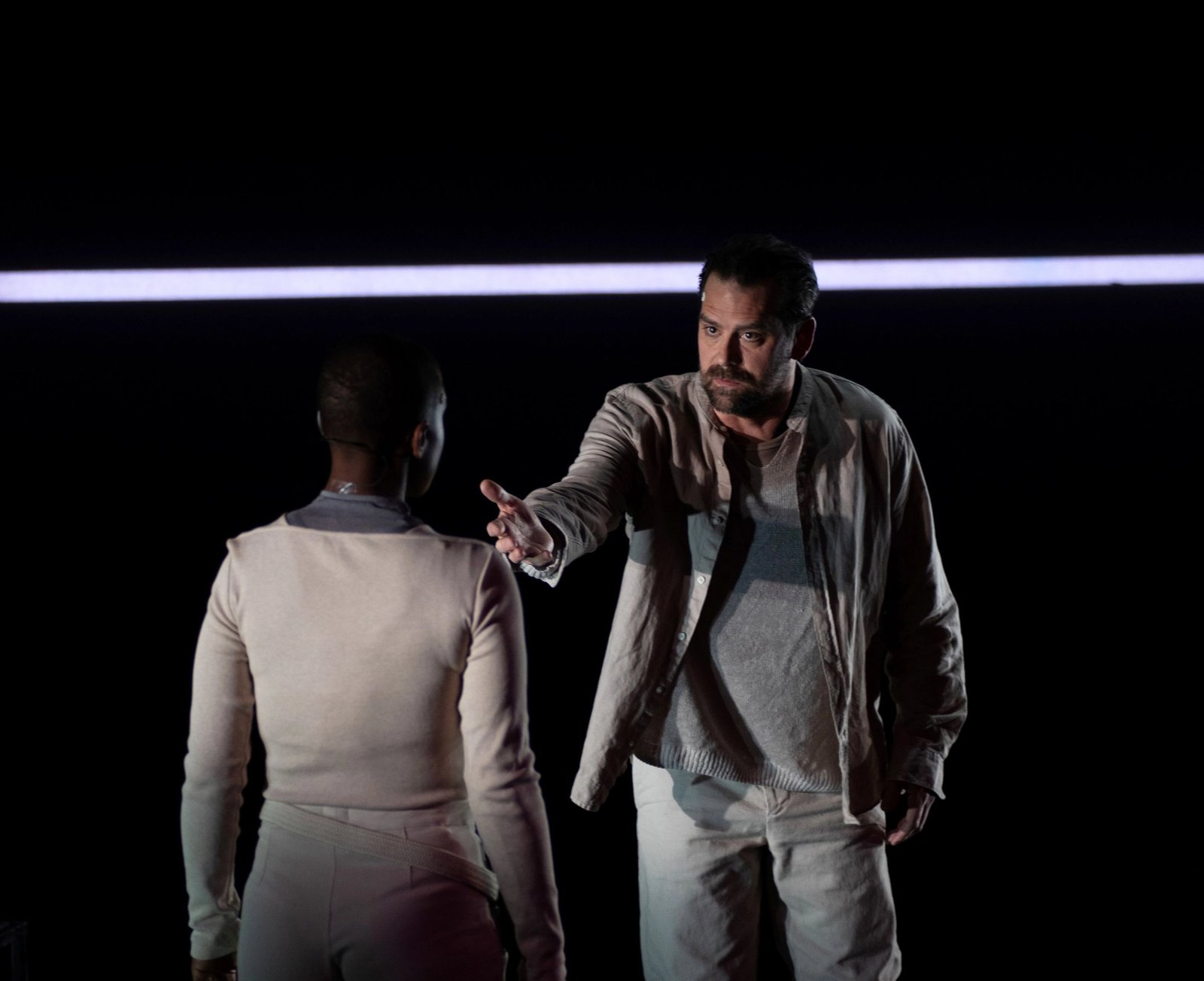
As the light dims, the two main characters slowly reveal themselves: Lomond, a curious rule bender and Niamh, a rigid rule follower. They are both stuck in a bunker in middle-of-nowhere Colorado. Lomond is a type of special agent referred to as a Seeker. Seekers have a special ability to enter and explore other people’s memories. His current consequential assignment forces him to meet Niahm, his estranged ex-wife. During this play, both characters attempt to uncover the conspiracy around Lomond’s latest mission. Suddenly a mysterious rock powered by artificial intelligence appears promising previously unseen memories in exchange for his own. Observed by skeptical by-the-book Niahm, Lomond slowly discovers that his employer, the US government, is responsible for the genocide of his people.
"Mechanically, the story could not progress if not for the intrepid inquisitiveness of the white man."
The play works as a piece of entertainment but it struggles to engage the importance of memory in a larger sense to the point where the whole story feels conspiratorial. In the original Francophone production, both characters were white. In the English edition, Niahm is played by Bénédict Bélizaire, a black woman, which adds a tension between the two characters, although I suspect it was not intentional. It is a shallow subversion of the usual trope, where the minority is expected to be the representative of the colonized. This casting change promises to be subversive at first but as the story progresses, both characters fall into another trope of the white savior variety. Niamh is annoying; she just wants to follow the rules and her instincts to comply are constantly proven wrong. She is too scared of what the government would do to her daughter, and her rigidity is framed as the reason she is separated from the father of her child. She represents what many conspiracy theorists would call the sheeple: people whose genuine fears are dismissed and their experience ignored. In contrast we are supposed to empathize with Lomond (played by Andrew Shaver), the white man who is willing to sacrifice his family to satisfy his seemingly random bursts of curiosity. Lomond is selfish in his quest for discovery, neglecting everything around him, and yet we are forced to follow him around patiently waiting for him to find whatever he is looking for, no questions asked. The plot only progresses with Lomond’s growing interest in other people’s memories. Mechanically, the story could not progress if not for the intrepid inquisitiveness of the white man.
"Past strict entertaining value, Seeker does not ask the questions that matter."
Centering the individual, specifically the white man is fundamental to conspiratorial world building: things like structural inequality would render his quest for heroism completely delusional. All conspiracy theories can truly do is offer simplistic explanations to complex structural issues. Most importantly, the privileged considers himself as the true savior of a system designed to benefit him first. The play takes place in an ahistorical United States, devoid of any concept of race or indigeneity but clumsily tries to tackle the genocide of Lomond’s people. It would have been a great opportunity to draw some parallels between the eradication of Lomond's people, who were the native population of his planet, with any current or past subjugation of native people in North America. Yet the kidnapping of his people in the final memory, is presented as a unique evil when this story takes place in a country with an immigrant kidnapping agency called ICE that constantly separates children from their families.
This flattening of structural discrimination is clearest in the ending of the play. Its conclusion implies knowing the truth is enough to stop suffering from happening. It leans into the neoliberal fantasy that the simple fact of awareness of injustice is enough and that the liberation will naturally follow. It leaves the audience to fill in the blank as if the information alone materially changes anything. It never interrogates the systems that even got him into the bunker. The AI rock pops in randomly and we, the audience, are supposed to believe that the same forces that trapped Lomond in this bunker with his ex-wife would allow a random rock to expose him to the truth. It resembles the delusion that a couple Google searches can help a high school dropout disprove the germ theory of disease, and take down Big pharma with said piece of information.
Overall I say that past strict entertaining value, Seeker does not ask the questions that matter. It feels right at home at the Centaur Theatre, which after 2 years of violence still refuses to to explicitly oppose the current genocide in Palestine. It is especially disappointing because the play was written during Covid, when the murder of Georges Floyd, and the storming of the US Capitol on January 6th happened. To present a show so flashy but devoid of insight is a missed opportunity to dig deeper and ask the right questions.
Seeker played at Centaur Theatre as part of their 2025-26 season, from April 5th to May 3rd, 2026.

 About Nikita
Nikita is a writer and creative based in Montreal. He experience in facilitator and community work has led her to launch Blackout productions, where she organize events for BIPOC creatives around the city. A member of the Quebec Writers Foundation, she has been featured in the Pit Periodical and other publications.
Read moreComments
No comments yet.
Be the first to speak into the void.