
The jokes hold a less-than-flattering mirror up to audience members who’ve never questioned history as told from the colonizer’s perspective. For us as racialized and critical viewers, their wisecracks often land with the warmth of being in on the joke.
With two years of Fringe accolades from festivals across the continent (and even across the pond) under its belt, it’s no surprise that Colonial Circus drew a full house for its one-night-only showing at Espace la Risée. The hour-long “immersive comedy” was a headliner at this year’s Montreal Clown Festival.
The show stars Shreya Parashar and Sachin Sharma, the Toronto-based South Asian duo known as Two2Mango. They’re armed with a self-described “neo-Bouffon” approach that combines the style’s signature mockery and grotesque costumes with whiteface — both in the clown and racialized sense. Their target? The history of British colonialism and the practices of white civility our present society has inherited. The result is a collection of moments of comedic reprieve for folks who struggle against colonial legacies in their day-to-day lives. Yet, we were left wondering–is that enough?
"The clowns proceed to take jabs at everything from the imagined exoticism of India to the fragility of white femininity. "
Audience participation begins right from the start — the clowns romping around on stage recruit us to mimic chants and silly noises in a call-and-response fashion. They then invite questions We’re invited to ask the clowns questions about themselves. It’s cheerful. Good fun and games. The majority white audience is eager to join in. But soon enough, the mood shifts.
The clowns transform into colonizers: a British Governor (Sharma) and Governess (Parashar), complete with over-the-top gestures and posh accents. “We need boat people!” exclaims the Governess, urging the audience to step forward as volunteer rowers. The colonizers are about to set sail on their voyage to “America”— in search of spices for the lady’s tea, of course.
The audience’s earlier eagerness to participate morphs into squeamishness. Finally, after much prodding and encouragement, roughly seven spectators join the clowns on stage as potential “boat people.” I (Danielle) wonder from the safety of the edge of my seat if the white volunteers see their willingness to suffer public humiliation as making some kind of noble sacrifice. I wonder if the racialized volunteers aren’t still a bit nervous to participate. Meanwhile, I (Dana) lean forward in my seat, at once intrigued and cautious; the harsher mockery of the style seems to be seeping in, the bouffons’ smiles subtly shifting to sneers.
Once satisfied with his troupe, the Governor produces a large measuring stick painted in a gradient of skin tones arranged from light to dark. One by one, each volunteer steps forward for assessment. He prods the audience to brand the volunteers either light or dark, reducing them to either side of a violent binary. Divergent and hesitant sounds arise from the audience—perhaps signs of confusion, discomfort, tension. My instinct (Danielle here) is not to play by the clown’s rules at all and instead vote everyone offstage to save them from the roast I’m certain they’re about to receive.
As the process continues, it becomes clear that this is a white-only boat; the bouffons kindly but promptly point everyone whom the audience brands “dark” back to their seats. The one visibly Black volunteer is trembling with laughter at their predicament as they await their turn. We (both Danielle and Dana) are relieved, somewhat, when the clowns emphatically repeat “we love you,” before ushering them and two others off the stage. Now, only those deemed white, or rather white enough, are left. The awkward tension in the room is palpable.
Thankfully, there’s no tension that a well-timed song can’t smooth over. As becomes a pattern throughout Colonial Circus, the duo haul the energy back from the brink of no return with a daring musical moment. This time, it’s a rollicking reimagining of the Jamaican folk song Day-O (The Banana Boat Song); as the volunteers row the imaginary boat forward, the clowns earnestly sing the tune’s modified hook: “May-O, May-O, mayonnaise is the spice of whites.”
Laughter explodes once more. “See?” the clowns seem to be saying. “We’re having fun. This is still fun and games.” Suddenly, the boat crashes. All the white boat people die, and the Governor and Governess parody white distress at the loss of white lives. The scene ends there, and the audience members return to their seats.
"Through their bouffonery, the pair have successfully turned the tables, and the joke is now on us. Well, sort of."
In this manner, the clowns proceed to take jabs at everything from the imagined exoticism of India to the fragility of white femininity. In a particularly striking moment, the duo ask if anyone in the audience is from India. A man towards the back of the house raises his hand and earnestly announces he’s from Gujarat. The duo’s eyes light up as they scramble towards him. They ask if they can touch his “spicy Gujarati hands.” The man hesitantly acquiesces, and I (Dana here) wonder about the capacity for whole-hearted consent when there are two persistent bouffons in front of you and a room full of people watching.
Through their bouffonery, the pair have successfully turned the tables, and the joke is now on us. Well, sort of.

The jokes hold a less-than-flattering mirror up to audience members who’ve never questioned history as told from the colonizer’s perspective. For us as racialized and critical viewers, their wisecracks often land with the warmth of being in on the joke. The clowns wink and nod in our direction. We’re invited to step behind the mirror, perhaps for a moment, and use it as a shield. There are even moments of fleeting satisfaction as we indulge together in minor revenge fantasies. For anyone who struggles against colonization’s legacies on the daily, it hits.
The show ends in a medley of mockery, tying together the sins of British colonialism’s past with its present horrors. Ashamed at the part they’ve played in the colonial project, the characters promise to take their white guilt and bury it deep beneath the ground, never to be seen again. They start to dig, only to find they’ve struck upon unmarked Indigenous graves in the process. Disaster!
“We’ll perform a land acknowledgement!” they promise. Cue Woody Guthrie’s folk classic This Land Is Your Land, which the supposedly repentant clowns use as the soundtrack for a frolicking dance around the stage. The scene is a fittingly ridiculous stand-in for performative land acknowledgements, which rush past true accountability and commitments to solidarity in favour of pleading forgiveness.
The spiral continues. But they are sorry! So sorry. Can’t you tell how sorry they feel? In case you couldn’t, the pair hang their heads before busting a move to Justin Bieber’s Sorry, exaggerating their contrition for the audience with finger hearts and pouty faces.
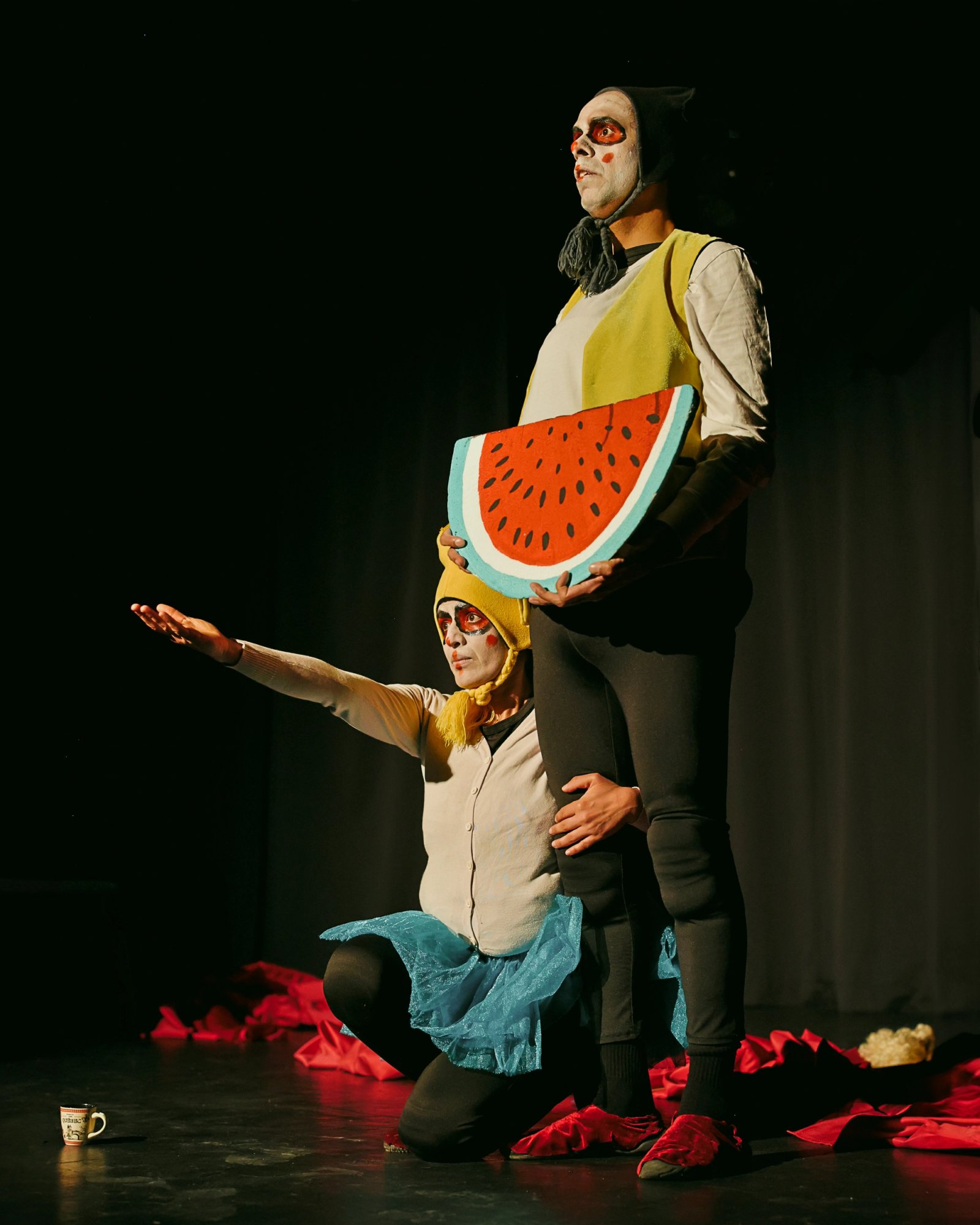
Suddenly, the music cuts. Blackout. Mere seconds later, the lights come back on to reveal the show’s closing image: the duo stand still and upright, faces blank and severe, while they hold a cardboard cutout of a watermelon, a popular political symbol that represents solidarity with Palestine.
The moment is an explicit and intentionally jarring turn towards the sincere — a clear nod to the genocide in Palestine and the continued legacy of British colonialism.
The moment has the potential to be powerful, but it feels far too brief. We have only a few seconds with this striking image before the lights go down, the applause thunders in, and the clowns return to the stage for their final bows. I (Dana) can’t help but wonder if the audiences are really able to take this in and consider how the show is pointing towards the entangled histories and liberations of Palestine, Indigenous peoples across Turtle Island, and India, as lands that were subjected to British colonial rule.
We’ve seen colonial white supremacy’s capacity to have it both ways—to laugh at its own absurdity, while raking in the profits from the popularity of such “diverse” productions and continuing to uphold itself. We’re left wondering, will Colonial Circus resist being co-opted as it moves beyond its humble Fringe beginnings?
Colonial Circus played at Espace la Risée on April 11 as part of the 2026 Montreal Clown Festival. You can find more information about Two2Mango on their website and their social media.
 About Dana
Dana Prather is an emerging writer and multidisciplinary creative hailing from Treaty 7 Territory. A recent graduate of McGill University, they hold a BASc in English: Drama & Theatre and Psychology. Previously, their writing has been featured in The Tribune and Scrivener Creative Review. Dana is based in Tiohtià:ke/Montreal.
Read more About Danielle
Danielle is a writer and editor based in Tiohtià:ke.
Read moreComments
No comments yet.
Be the first to speak into the void.