
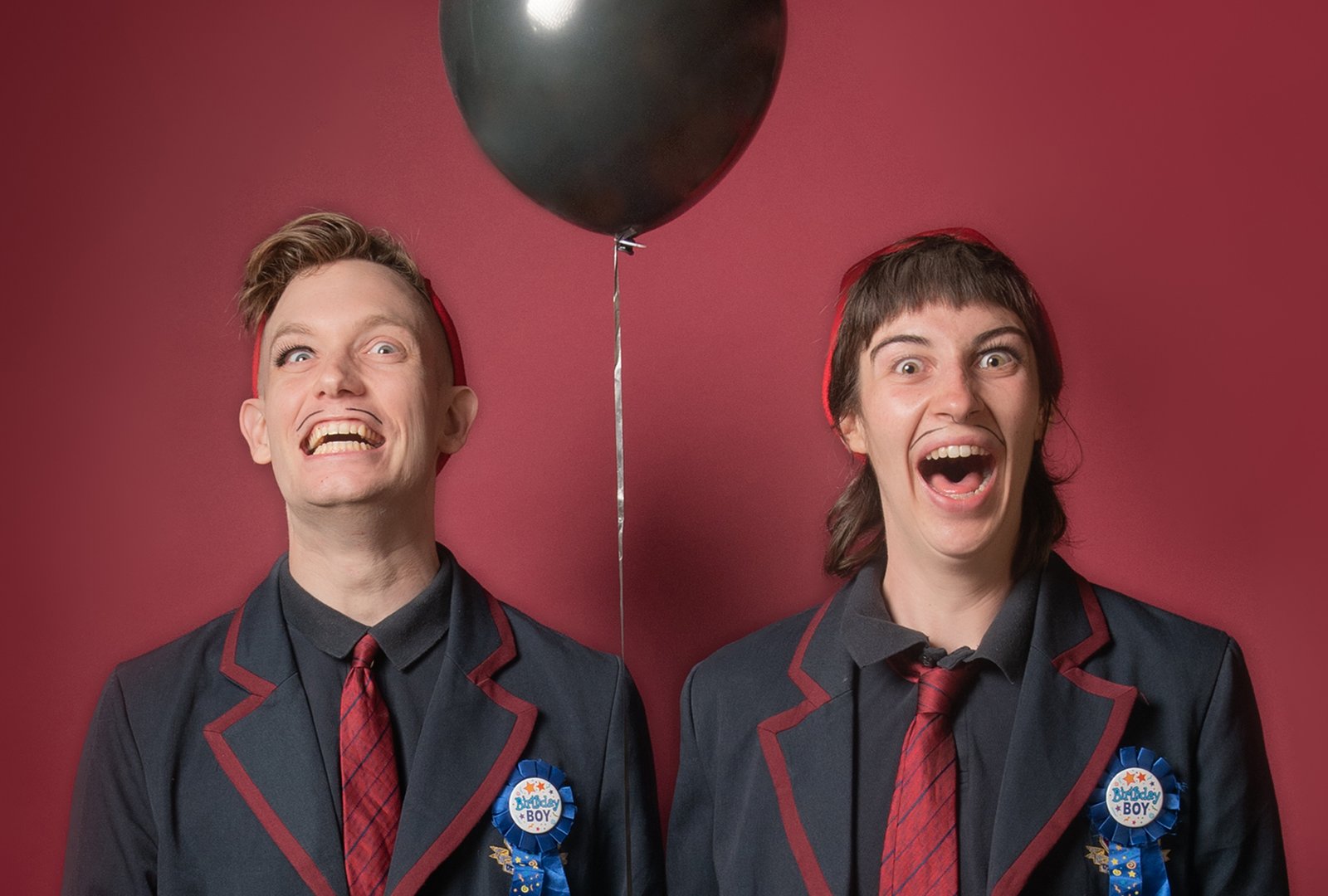
Grummet and Kruger deliberately test the audience’s comfort with an unsettling proximity that challenges what is considered acceptable.
What unfolded on La Sala Rossa’s stage during the Montreal Clown Festival’s show “The Creepy Boys,” is far from “creepy” in the Pennywise sense of the term. Instead, it was an exuberant, chaotic performance. S.E. Grummet and Sam Kruger, the duo who are an adult couple offstage and play 12-year-old twins going on 13 on stage, invite the audience to let go, to laugh, and at times, to question how far they are willing to follow.
“Creepy” itself seems to shift meaning as the show goes on. It appears in moments of heightened intimacy, sexual tension, and an insistence on gestures that verge on “too much.” Grummet and Kruger deliberately test the audience’s comfort with an unsettling proximity that challenges what is considered acceptable.
Excess is both the show’s strength and its point of friction.
The performance moves across temporalities, from childhood to adulthood, interwoven with nostalgic references–particularly to Y2K culture. The accumulation of scenes, however, does not necessarily resolve into a coherent narrative. Thus, a central tension emerges: this layering creates both a sense of possibility for exploring queer bodies and a loss of clarity.
From the outset, the performers establish a direct relationship with their audience: they hand out balloons as we prepare to celebrate the characters’ 13th birthday. Although it’s not entirely clear or explicit, it seems the two are siblings or maybe even twins–given their sometimes matching behaviour, exact same outfits, and the way they mirror each other’s movements and speech. Audience participation is encouraged. For example, a truth-or-dare segment later on in the show brings an audience member into an intimate, almost transgressive act off stage. The boundary between stage and audience remains porous at times, and the duo maintain a strong grip on the room.
Grummet and Kruger reveal that the show is also the Creepy Boys’ 100th show together, and it shows–they have a clear command of timing and presence. Laughter is constant, even in response to the smallest gestures, pauses, or shifts in energy. Formally, “Creepy Boys” draws on physical and absurd clowning. Traces of drag and queer performance aesthetics are visible in their wide-eyed stares, stretched smiles, and twitching faces. It’s also present in their uniforms and red berets, worn almost too neatly. Their bodies often lean in too close to one another—hovering, touching, lingering just a moment too long.
The show feels deliberately infused with chaos. It is structured through repeated and escalating actions. For instance, at one point the duo simulates birthing each other. In another scene, a seemingly playful dare from the audience to kiss turns into an overly long, visibly spitty exchange. Framed by their presentation as siblings or twin boys, this moment takes on an added layer of awkwardness. These moments of excess disrupt expectations and resist a clean, structured narrative arc. At the same time, this excess does not always land evenly. At moments, the dialogue, its rapid acceleration, and the density of gestures all overlap, and make it difficult to follow. The audience’s laughter occasionally felt hesitant or delayed. Excess is both the show’s strength and its point of friction.
The fact that the duo is a couple offstage adds an interesting layer, though it never becomes the central focus or fully visible onstage. This knowledge of their relationship offstage sits uneasily with what happens onstage, where closeness is stretched and repeated. What emerges is less a representation of queer identity and more a space of possibility, where elements of domesticity—shared space, proximity, small gestures of care, of play—are present but never quite settle into something stable.
Held too long or repeated, these moments shift from familiar to awkward. They become an exploration of how intimacy, domesticity, and desire can be performed differently, without being explicitly named. The exploration of new ways of being together is embedded in the Creepy Boys’ gestures, their ambiguous kinship, and the ways their bodies become entangled on stage. At the same time, these methods of exploration sometimes make it difficult to clearly grasp what is happening.
As I’m leaving the performance, a couple of questions linger for me. Chaos can function as a political tool by disrupting familiar ways of seeing and feeling, unsettling norms around intimacy and the body, and opening space for forms of relation that resist easy recognition. However, does a performance like “Creepy Boys” open space for reimagining queer bodies on stage, or does it simply displace familiar codes without transforming them? And perhaps more importantly, how far can chaos function as a political tool before it begins to obscure the very possibilities it seeks to create?
Creepy Boys played at La Sala Rossa as part of Le festival des clowns de Montréal on April 14th, 2026.
 About noor
noor performs, studies, dances, watches, loves, eats, learns, and, most importantly, unlearns (in no particular order), among other verbs. noor moved to Tiohtià:ke from New Delhi at the end of 2024 for a PhD. Since then, noor has been making new friends, exploring the city, finding a 'fun' job, and trying to meet a deadline (or two or three). noor is a co-director of B25 and works across Hindi, English, and French.
Read moreComments
No comments yet.
Be the first to speak into the void.