
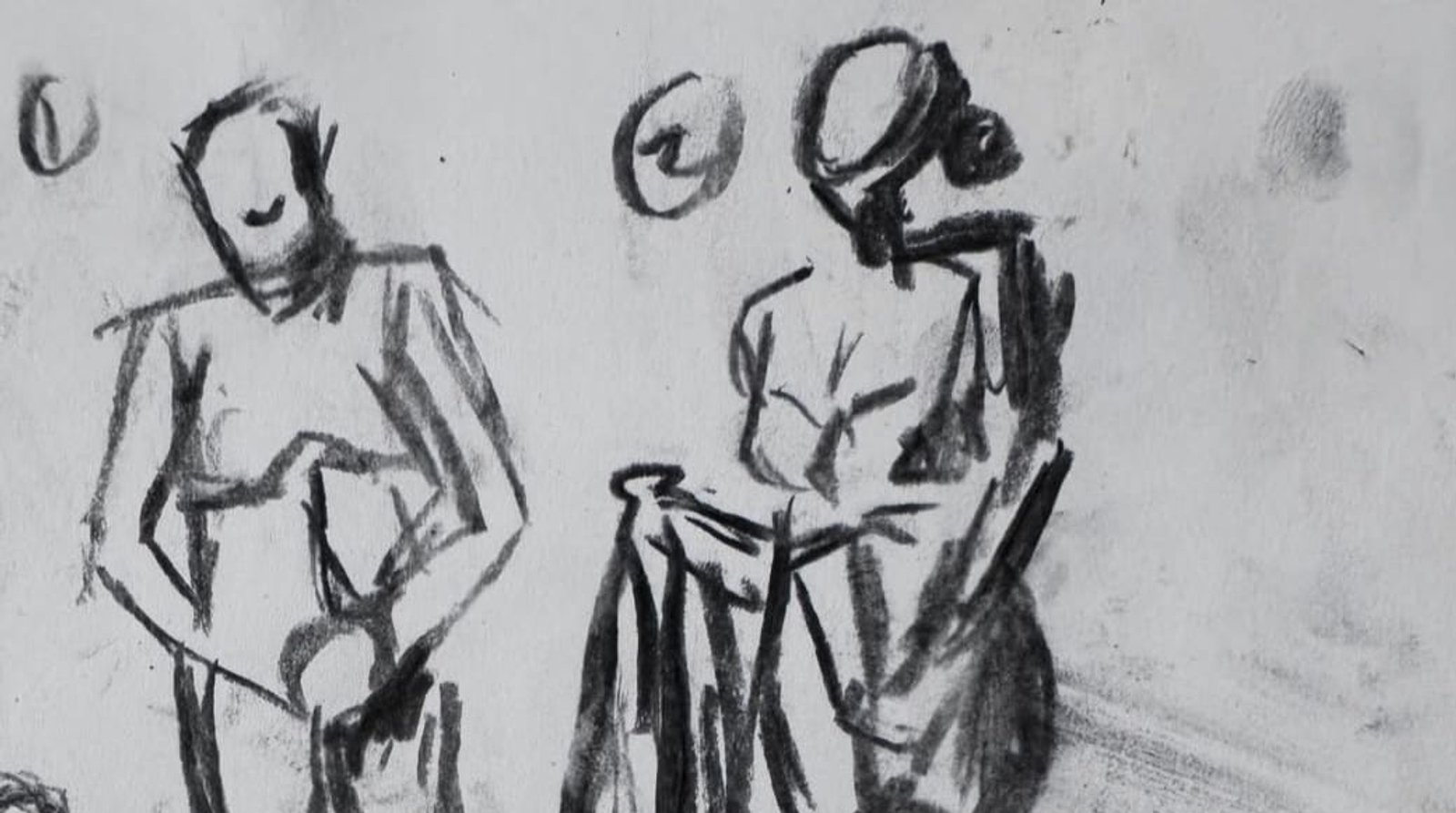
The show starts with the voice of the white man, godlike, telling us and the lone performer on stage what to do. We draw her as she poses for us, in what we assume will be the most nude we will see her, holding an onion at her crotch.
Drawn gives and takes.
Nothing in this world can hurt you…
The show starts with the voice of the white man, godlike, telling us and the lone performer on stage what to do. We draw her as she poses for us, in what we assume will be the most nude we will see her, holding an onion at her crotch.
gender violence, sexual violence, rape…
She poses and we hear about the statue of Venus, Aphrodite, beauty, and men’s evasion of responsibility as the main enactors of violence, gendered and otherwise.
She birthes a plant in a pot, soil pouring out from between her legs, and we frantically draw the leaves of the plant, because we don’t know what else to do with ourselves.
She bends down and puts a target on her butt, the white man preaches about consent and touch, and we are instructed, by him, to hit the bullseye with papers wrapped around a small rock. Clear by that point that the white man is in charge of how her body moves and what she does, the audience holds still for a moment, before the first rock is thrown to the stage, away from her body, all the way to the side. A shower of rocks and papers ensues, none touching her. I breathe a sigh of relief, hoping upon hope that this is the result of our collective decision to disobey, and not our collective bad aim.
Iris Vaguada, the writer and performer of Drawn, is mesmerizing to watch. The movement of her face and body is enchanting and skillful. Each of her limbs is a puppet of its own. The soundscape, composed by Léa Spatz, flows through her and is guided by her just as much as it guides her.

After a short intermission, Iris comes back, now truly nude, and starts speaking about her Chilean roots, onions, songs, her (perhaps fictional, perhaps real) experience of sexual assault, and her family’s lack of support. It is in this second half that we finally hear Iris’s voice and will, and not the white man’s. In comparison to the first half, when we were so struck by what we were seeing on stage that we could barely get ourselves to respond to the audience interaction prompts, the second half feels more in-progress. In a shift towards more personal storytelling, the piece loses some of its theatricality, and most of its sharpness.
Bringing a personal element to the previously political statements felt placating. There was a tension built in us by being directly implicated in objectifying a woman’s body, who seemed to hold no autonomy over herself, by drawing her and interacting with her body according to a white man’s instructions, that brought up potent feelings and thoughts – of resistance, of shame, of righteousness, and of anger. Hearing of a personal story of childhood, cultural roots, and trauma eased that tension out of me. For people like me, who are looking to be moved at the theatre, it was a disappointing turn of events to end on such a note. But a disappointment worth bearing, if only to experience being in that room again, watching Vaguada stand still, and stir our hearts and minds.
Drawn by Nanai Studio is playing at PlayShed as part of Montreal Fringe Festival’s 2026 programming. As of the day of this review’s publication, they have 4 shows left: Wednesday June 17 at 19:15; Friday June 19 at 17:30; Saturday June 20 at 15:30; Sunday June 21 at 19:00
Find more information and tickets on the FringeMTL website.
 About Banafsheh
Banafsheh Hassani بنفشه حسنی is an Iranian feminist theatre artist based in Montreal. Their passion and belief in the value of cultural criticism and the significance of loud racialized voices led to the creation of DIS in 2026.
Read moreComments
No comments yet.
Be the first to speak into the void.