
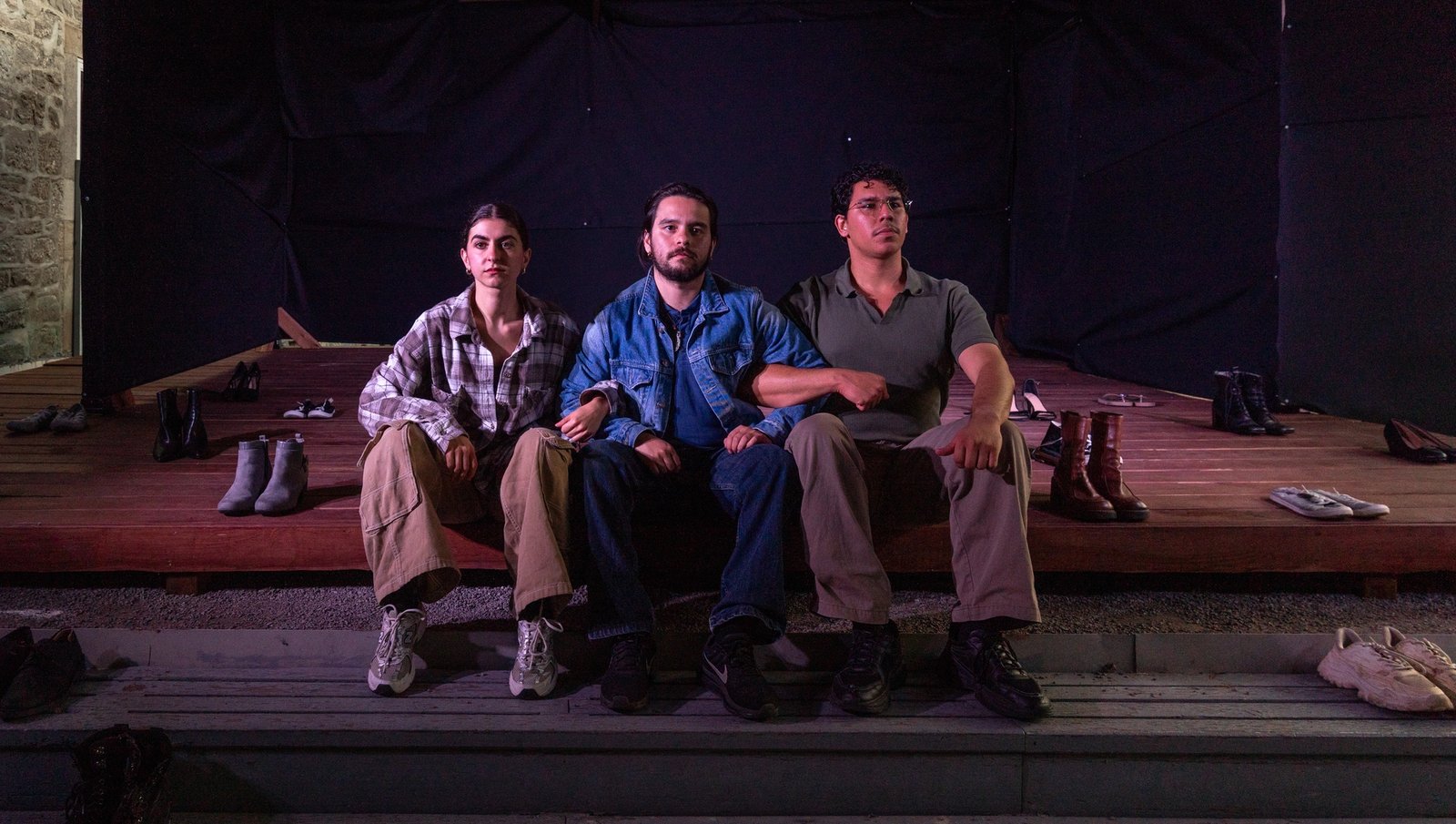
Echoes in the Street attempts to weave together a history of student protests in Montréal, beginning with an all-too-brief history of the student protests of 2012.
As I got off the 80 on the corner of Avenue du Parc and Des Pins, I walked towards Teesri Duniya Theatre with an empty head. With the new theatre season slowly starting, I felt a sense of excitement at the prospect of watching new experimental performances. Teesri’s Backyard Theatre Festival, described as “an activists’ answer to the summer festival season,” seemed right up my alley, so I was SAT. I am familiar with Teesri’s programming, but I was particularly excited to attend the launch of their outdoor theatre space, which overlooks the stunning courtyard of the Cité Des Hospitalières. The stage where the show took place had three mounted black walls, like a three-sided box. As I sat down, I faced a stage scattered with several pairs of shoes. It was the first cold night of the month, and I felt freezing as I impatiently waited for the show to start.
Directed by Abi Sanie, Echoes in the Street opens with three performers — Julia Pye, Sebastian Quint, and Joshua Bilbao — playing themselves. Against some background music, they perform repeated gestures that toe the line between choreographed dance and freestyle movement. The work attempts to weave together a history of student protests in Montréal, beginning with an all-too-brief history of the student protests of 2012. The largest student demonstration in Canada’s history, this landmark protest saw CÉGEP and university students across Quebec fight against tuition hikes proposed by the Liberal government. We, the audience, were then invited to march alongside the actors in a fake march in the garden before returning to our seats to watch the performers change their shoes as they taught us the lyrics to Bella Ciao, an Italian song written by antifascists in the mid-20th century. The show ended quite abruptly with a repetition of the initial choreography.
Echoes in the Street was an ambitious attempt that felt disjointed. The term “echo” is appropriate here; the play struggled to trace a coherent, legible history of student activism, instead presenting passing references to student protests without really delving into their impact, their motivations, or even their purpose. I was especially disappointed that the immense victory that the students achieved was left unacknowledged: the tuition hikes were cancelled, and the Libéral government later lost in the following elections. For audience members with no prior knowledge of these events, differentiating between the various protests and movements highlighted would be a difficult task. I myself was a student during the 2012 protests, and at times, it was even unclear to me which protests were being presented!
Furthermore, there was very little mention of the city of Montréal’s or the province’s relationship to protests. This felt like a missed opportunity to underline Québec’s long history of proletarian solidarity: it remains one of the most unionized provinces in the country. Even in English-speaking history, there was no mention of the 1969 sit-in at Concordia University, where black students protested against a racist biology professor. Walking into this piece, I was excited to learn and to feel hopeful. Instead, I felt lost. Every chance we had to dig deep, we were jolted back to another confusing dance. The performers were clearly prepared, but it felt like a surface-level exploration of Montreal student protests written without enough research or time spent considering how to tackle such a heavy topic.
At less than an hour long, the show’s run-time felt rushed and inadequate to dive deep into the causes or tangible histories of the protests. This subject matter is quite urgent and timely; there is currently a shift in public opinion concerning the genocide perpetrated by Israel, and I am certain that student protests all around the world, including ones here in Montréal, contributed to that change. Simply put, I wish that this performance gave this praxis the time it deserves.
Echoes of Silence was performed at Teesri Duniya Theatre as part of the Backyard Theatre Festival on September 10, 11, & 12, 2026.

 About Nikita
Nikita is a writer and creative based in Montreal. He experience in facilitator and community work has led her to launch Blackout productions, where she organize events for BIPOC creatives around the city. A member of the Quebec Writers Foundation, she has been featured in the Pit Periodical and other publications.
Read moreComments
No comments yet.
Be the first to speak into the void.