
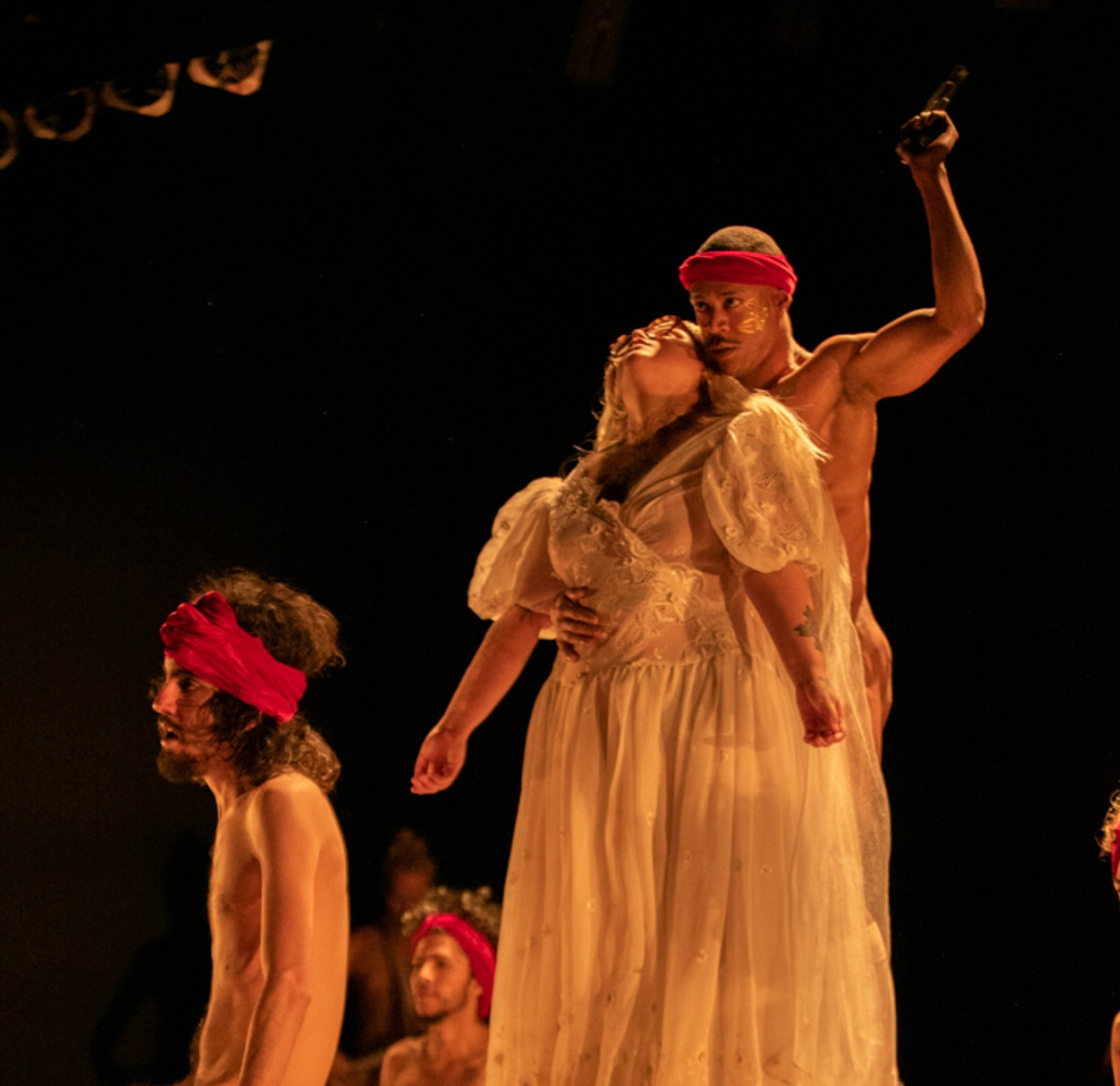
The inspiration from Bataille becomes evident in the execution of the play. The boundaries between audience and actor, between profane and sacred, between good and bad taste; they all dissolve.
There is something so special about performing arts. Every performance can leave you changed, and awaken some parts of your psyche that were long dormant. I walked to Usine C with very limited information. As afternoon and night met, I ordered my first aperol spritz of the season and tucked into my seat.
The mechanics of “História do Olho” are very simple: the performers all confess their relation to pornography in between recreation from Georges Bataille’s book Story of the Eye, specifically the narrative part. I am familiar with Bataille’s work, particularly his text Eroticism, where he explores the influence of sex in, well, almost everything. The show calls itself a pornographic fairytale, a description that conjures in the mind images of a bricked up Beast (pre transformation) or Snow White with a BBL. Instead we witness a queer celebration of the body and the carnality that lives within all of us.
What could have been inappropriate in another context becomes humanizing.
At first glance we have all the trappings of shock pornography. Immediately, transgressive and lewd acts follow in rapid succession: one actress masturbates loudly in a closet, another actress pees on her friend as he tumbles between her legs, then the same tumbling man furiously humps a mannequin to destruction. We see most of their genitals before we learn their names. But as the show progresses a gentleness creeps in. The actors and their diverse bodies are naked the whole time, but act with a warmth that establishes a trust with the audience. Many of them are sex workers themselves, and perhaps their experience explains the ease with which they reveal their bodies and their favourite part of the book. So much so that you are enticed to participate to immerse yourself in their world.
Cheekily, and gradually, the performers invite the audience to participate. Brave individuals suddenly bare themselves to the crowd. One person shares his love of feet. One graciously agrees to spank a performer with the copy of the source material. One man even flashes us! What could have been inappropriate in another context becomes humanizing. We take a brief break from the frenzy in Bataille's perverted musings to get to know each other. The inspiration from Bataille becomes evident in the execution of the play. The boundaries between audience and actor, between profane and sacred, between good and bad taste; they all dissolve.

If the first part of this performance was foreplay, the second part was when things got very intense. After a 20 minute intermission where we served cachaça, we were invited on the stage. An audience member is given a very detailed and gentle tutorial on how to fist a woman. I was almost compelled to take notes, it was very informative!
The culmination comes right after the fisting. We witness a concept central to Bataille work called a limit experience, where horror and ecstasy become indistinguishable. This happens in the play where a performer we had not been introduced to is hooked to a rope and suspended in the air by only his skin. Despite my aversion to body horror I was unable to look away. The show concludes with a soft reading of the end of Bataille’s narration by the playwright. After 3 hours of exciting performance I can't say I remember much of that part.
This is by far the best play I have ever seen at FTA, maybe even in my life. The performances made me feel alive in a way that rarely happens (at least without mind-altering substances). It really made me want to read more of Bataille's work. It did what art does best: diving past entertainment to explore themes found in one form of art with another.
I left the theater listening to Freak by Lana Del Rey: it felt fitting.
Historia do Olho was performed at Usine C as part of FTA 2026, On June 6,7,9 & 10, 2026.
 About Nikita
Nikita is a writer and creative based in Montreal. He experience in facilitator and community work has led her to launch Blackout productions, where she organize events for BIPOC creatives around the city. A member of the Quebec Writers Foundation, she has been featured in the Pit Periodical and other publications.
Read moreComments
No comments yet.
Be the first to speak into the void.