
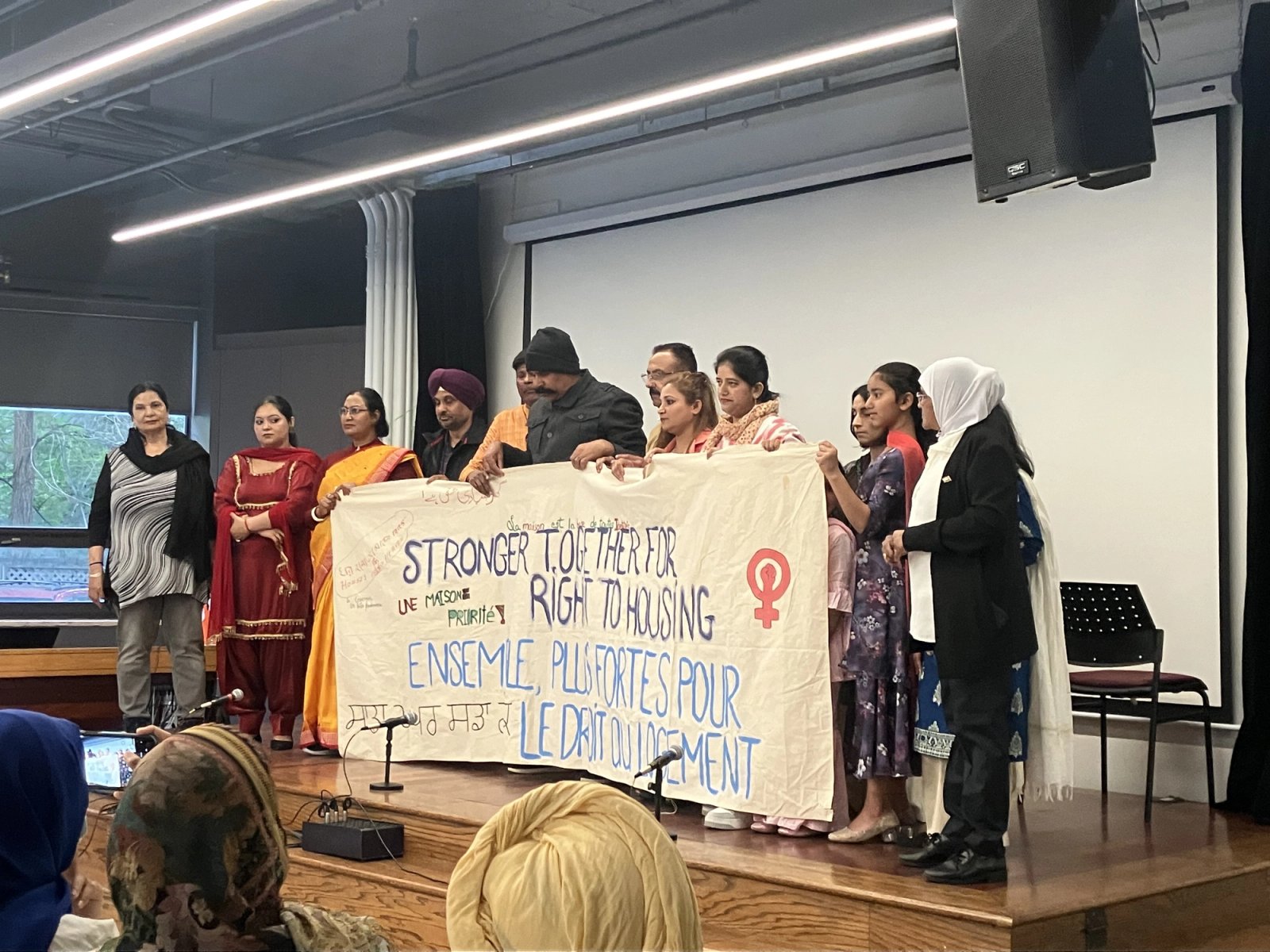
Jaye to Jaye Kahan" translates to "where do I go, if I go?" It attempts to portray the difficult limbo in which many immigrant lives are stuck. This is a tiring bureaucratic, financial, social, cultural, and linguistic limbo that takes both a mental and physical toll.
“The immigrant belongs neither here nor there; it's just the constant grief that keeps killing them. Our luck was just terrible, or perhaps this is how it is by design. ki dassiye duniya nu? // What do we even tell the world?”
I translate these words from Punjabi, from one of the many songs that I heard in the play. These words, which of course do not do justice to the kind of affect that they caused within me, still carry a lot of weight for me. I listened to it in a language that is close to home, at the same time carrying the depth of a lived reality. It is still hard for me to take it out of my brain; maybe it is etched there for now, for some time at least.
It was a rainy day in Parc Ex and I had thought I was running late for the play Jaye to Jaye Kahan. To my surprise, it started half an hour later than the mentioned time, maybe they were running by desi time as they say. The play happened in a building which houses several community organisations in Parc-Ex. The small auditorium here was packed up with aunties and uncles from the surrounding neighbourhood. There were many children; it was a very animated setting. I saw there would be samosa and chai after, which made me lock in all the more. As I was waiting for the play to start I recognised some familiar faces and met some friends.
Before the start of the play, Nitu Sharma, the director of the play, made an important proclamation: If theatre can happen in French or English here in this city, then why not in Hindi or Punjabi? It rings true for me and what we, at DIS, believe: the need to fill the dearth of theatre happening in the languages we speak, despite the diversity of the people this city holds, and the lack of plurilingual theatre reflecting that said diversity. Nitu goes on to ask us: Why do we do theatre? In her words, it is to find solutions, come together and witness together, and to help what we call community. This statement resonated deeply with me. I have always leaned on this part of theatre so much. Theatre makes you feel seen, held, in what we might call a community. This is especially felt when you are a part of experiences like this one. Nitu goes on to tell us that the play is led by a team that comprises community members who have had direct experiences with immigration, and who have written, created, and devised the entire performance, including all the songs.
Jaye to Jaye Kahan translates to where do I go, if I go? It attempts to portray the difficult limbo in which many immigrant lives are stuck. This is a tiring bureaucratic, financial, social, cultural, and linguistic limbo that takes both a mental and physical toll. For some who have left their homelands for a promising future in this country, every day is a struggle. Especially when finding a job that pays well enough feels like taking a shot in the dark. This struggle is exacerbated by the linguistic barriers and impositions, as well as the increasing costs of living. This play is an ode to that everyday struggle which finds expression and resilience in quiet, everyday moments. Theatre makes this possible, allowing the struggle to be played out in front of the many who live this reality every day.
The play opens with a nominal setting, with a table and a couple of chairs, and shows an exchange between two friends who are trying their best to navigate the francophone side of the job market in Montreal. The play weaves distinct scenes together where lives of immigrants play out in the mundanity: two friends having an exchange about jobs, a conversation between a husband and wife, several aunties in the neighbourhood talking to each other, three friends back home talking about their plans to go to Canada, among a few other scenes.
This play is an ode to that everyday struggle which finds expression and resilience in quiet, everyday moments. Theatre makes this possible, allowing the struggle to be played out in front of the many who live this reality every day
In the opening act, one of the friends mentions the need to carry a CV all the time, as is the reality in many people's lives. They also tell us about the extended difficulty of getting a job when you are an immigrant and starting from scratch. We then see a funny scene where they are trying their best to get around the French-speaking receptionist in an office. Soon there is a respite when the person in charge who appears is a Hindi speaker. However, while things might have gotten easier for them at the level of language familiarity, the job itself was a different kind of burden: making big boxes with an hourly wage of eight dollars.
In another scene, we see three friends back in their country of residence, playing cards together. They are thinking of their dreams of going to Canada and imagining themselves in this different world that they have never visited. One of them has found a job (in Canada), and is soon going to be gone.
The next part of the performance goes to a presentational-mode, bringing us closer to the statistical reality of what we just witnessed. We are told 65% of Parc Ex is composed of the immigrant population. Montreal also holds a lot of poor people and most of them are concentrated in this neighbourhood. We see several other statistics about the neighbourhood reflecting on the lived realities of the many immigrants in Parc Ex, including housing and rent increase, among others. The presentation of these statistics in Hindi-Punjabi to an audience of mostly Hindi-Punjabi speakers was instructive; it brought forth the rights that the community members could exercise vis-à-vis rental housing and landlords.
The entire play was punctuated with soul-crushing voices of the two singers that sang original songs, and elevated the experience to another level, giving me goosebumps. The lyrics were embedded with sharp critiques of the present state of the immigrant population. The songs that carried the depth of their pain and helplessness also carried with them a reality that we live around us but don’t come face-to-face with. In the many silos that exist in this city, we don’t see many theatre-goers and makers who go through the heavy side of immigration. Watching this performance, which laid bare so many truths, made one thing feel urgent to me: the need to bring such plays beyond the Hindi- and Punjabi-speaking community of Parc-Extension, and to bring outside audiences in to witness them.
The stories and songs woven together in the play addressed nuances and contexts that rarely make it to mainstream theatre. These stories making it to mainstream theatre stages can only be possible if we, who produce, create, and write about theatre, support and give resources to such community-based small productions to be played at bigger stages, especially for audiences outside the immediate context of where it is made.

The play ends at a grim note. The friend who had left for Canada is found freezing in the cold and finally succumbs to his death. This instance is not fictional but talks about the death of Manjeet Singh, a father of two and an unhoused immigrant in Parc Ex, who suffered this gruesome fate in the harsh winter of the city last year. Immigrants arguably constitute the backbone of any city; however, systemic inequities force many to unlivable conditions because of intentional, structural disparities.
I am reminded of Nitu’s words again: we need to push for what theatre can do, to make space for people to share, witness together, and even to help each other. While the helplessness we witnessed echoes the words from the song ki dassiye duniya nu? What do we even tell the world?
And, I add: one which doesn’t even seem to listen to us.
Jaye to Jaye Kahan was presented by Center for Performing Arts, which is a Montreal-based Punjabi language theatre group which was founded in 2022 by Gaurav Sharma and Nitu Sharma. This play directed by Nitu Sharma was performed on June 19, 2026 at the auditorium of 7000 Av. du Parc, Montreal.
 About noor
noor performs, studies, dances, watches, loves, eats, learns, and, most importantly, unlearns (in no particular order), among other verbs. noor moved to Tiohtià:ke from New Delhi at the end of 2024 for a PhD. Since then, noor has been making new friends, exploring the city, finding a 'fun' job, and trying to meet a deadline (or two or three). noor is a co-director of B25 and works across Hindi, English, and French.
Read moreComments
2Sonia
What a beautifully written documentary! You didn’t just describe the play—you preserved its soul and the powerful message it carries. Thank you Noor for your wonderful effort.”
Amina
Noor this is a wonderful message and I thank you from the bottom of my heart.