
What unfolded was something in between: part showcase, part open rehearsal. Somewhere in there, a gesture toward pedagogy that did not quite arrive. I left not entirely entertained, not entirely educated, but not empty-handed either.
This was my first visit to Centre Sanaaq, a sprawling space with coffee, books, exhibitions, and a large auditorium. The building itself was imposing. I felt a flicker of apprehension as I stood outside, taking in its size. The centre has only been open a year, and there is still something slightly uncharted about it, a sense that it is still figuring out what kind of place it wants to be. Since I was early, I slipped into the café, opened my laptop, finished some work, and let the space settle around me. By the time the event was about to start and we began queuing to enter the auditorium, I was at ease, or as at ease as one can be before sitting on a stage.
The crowd was initially thin, and more people started pouring in. I had assumed this would be a “spectacle,” based on the rest of the Festival Accès Asie programming, which featured produced shows and polished presentations. That set my expectations. Instead, there was no stage design or lighting, just a bare proscenium. Small round cushions were placed there so people could also sit on the stage in a semicircle. Before the start, the audience was asked to sit near or on the stage, as there would be interactions. I dared to sit in the first row. David, one of the artists, then asked me to sit on stage. I joked about not getting too much attention for the day and perched on the corner seat with my small notebook.
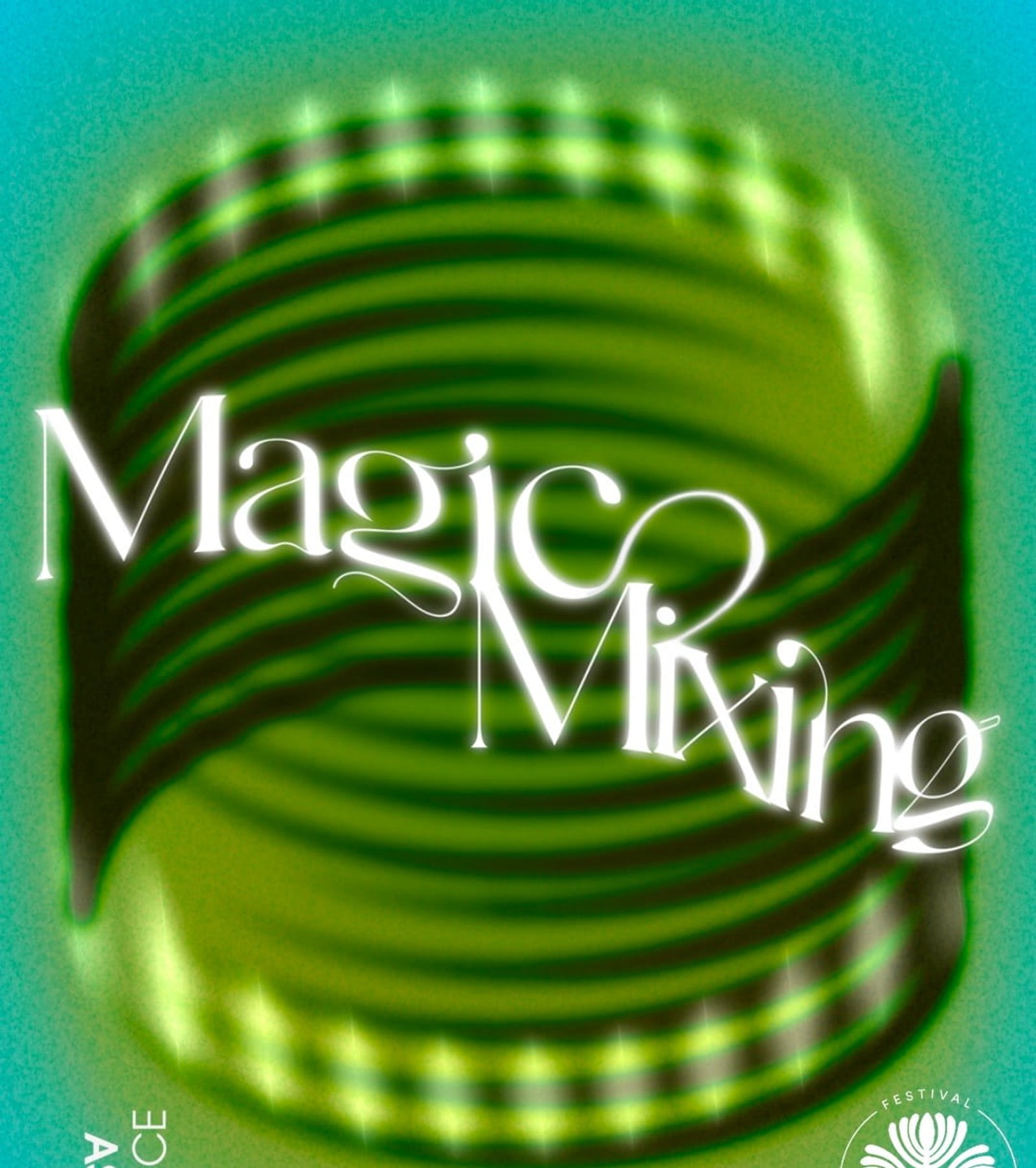
The event started soon with disclaimers. Angie Cheng, the mentor for this residency, told us we would witness an intimate gathering of two artists who had never met before the residency. The second edition of Magic Mixing (Mélange Mystique in French) was the result of their distinct yet connected histories and discoveries through a common medium: dance. I later looked up the first edition. The format holds across both: two Asian diaspora artists from different practices, a week in a studio together, and then an audience. The program has always focused less on producing a finished work and more on what happens when two very different bodies share the same room long enough.
How do we begin to take the ephemeral seriously, not as a lesser form, but as a different demand on our attention, presence, and what we are willing to call the evidence of art having happened?
What followed raised a question I kept returning to: what does a week-long dance residency produce? How does a single hour and a few minutes of public presentation do justice to it, especially when the medium is dance? Unlike painting or film, dance leaves no lasting archive for the audience to take home. I am not sure I have an answer. What I have is a dilemma, and this piece is as much an attempt to sit with that dilemma as it is a review.
For Leo Leung, aka CAPSLOCK, it was his first-ever dance residency. He has been involved in Campbellock, or locking, for eight years in Montreal, presenting his art in street dance battles within and outside Canada.
For David Norsworthy-Shibatani, a Toronto-based choreographer and dance artist, it was also his first residency of this kind. A graduate of The Juilliard School, he works with contemporary dance and improvisation through a lineage of American and European modern and post-modern dance.
The residency’s core was the two artists coming together. Leo described the days: seeing performances, eating, moving, building a friendship, and laying the foundation for what they’d present.
To begin, the two artists started with warm-ups in front of us. Leo explored possibilities in his body through bouncing, jostling, shaking, and trembling, while David introduced the warm-up as a return to dance class origins, seeking the body’s flow. This marked the event’s transition from gathering to performance.
Then the event moved into the core. We saw Leo and David dancing. They never danced together, always separate, as an audience member later noted during the Q&A. Leo’s dance had evident hints of Locking, Hip-Hop, and hand-leg coordination. David’s movement showed traces of gymnastics. It seemed like a dance-off at first, but it was clear it wasn’t. For Leo, the goal was to dance, focusing on each body part and concentrating on the space to ground himself.
Then the other round began. For Leo specifically: fast music, super-slow movements, and some laughs in the audience. The dissonance between the music's speed and the movements of the body was unmistakable. For the first time, expressions crossed Leo’s face. Angie, who had been present throughout, gently asked what emotions came up. Leo mentioned feeling frustration and tension, but also a kind of letting go, a surrender to that frustration, feeling into the music's textures.
During this part, David struggled to move his body. We would later know why. He called this useful tension: the body relaxed, but sometimes too relaxed. Nothing happens; the music doesn’t activate the body, and you struggle in public. The tension was palpable. He went on without music; Angie registered her uncertainty with the choice. We watched David try to find a rhythm in the auditorium's ambient sounds, coughs, intent stares, some people on their phones, some beginning to leave. I felt it too. I perform, and something in me was tracking both what was happening on stage and what was happening in the room. The attention shifted, restless, quiet exits. I found myself trying to inhabit his position, asking what I would do if my body refused to cooperate in public, in front of strangers who had come expecting something. The answer, honestly, was that I did not know. And maybe that not-knowing was the most honest response the room had to offer.
To conclude, the audience was invited into an improvised movement session. A few participated, dancing to the music before sharing their experiences: some described awkwardness, others playfulness, and one noted a soreness in their arm that directed all their movement.
And maybe that not-knowing was the most honest response the room had to offer.
Before the event ended, David returned to that earlier moment, speaking about the tenderness he had felt, linking it to his recent burnout. He spoke about how we often push our bodies until they're depleted. He shared his thoughts: the public pressure to make something happen, to show up for himself, to offer something to the audience. A member of the audience noted that David stood alone in the corner while everyone, including some audience members, danced, highlighting the difficulty of that moment.
For me, the event became more a question of pedagogy, but also of what residencies do. I stayed till the end, wondering why. Partly, I stayed because I was sitting near the stage from the start. Partly, because something in the room kept pulling me forward, some unresolved thing I wanted to see through. Was it curiosity? The performer in me, still trying to feel my way through what I was watching?
How does one do justice to the time and efforts of the two artists through this presentational output? Is it just the artist’s responsibility alone, or does it also fall on the audience?
Are we willing to sit with incompleteness, with a body that will not move on command or with work that has not resolved itself into something receivable? There is a larger frame worth sitting with here: this is a festival dedicated to Asian diaspora artists. Both Leo and David bring that into the room. But does their presence, their proximity for a week, and their two bodies in conversation, across very different dance lineages, do the political and cultural work that presence is sometimes asked to do? I am not sure.
How do we show what comes out of an art residency, especially one that lasts a week, and a dance residency at that? The audience often comes expecting a spectacle or at least entertainment. What unfolded was something in between: part showcase, part open rehearsal. Somewhere in there, a gesture toward pedagogy that did not quite arrive. I left not entirely entertained, not entirely educated, but not empty-handed either.
If we take seriously the idea that not all art needs to leave an object behind, then the ephemeral has its own logic, demands, and form of evidence. The question is not only how to document the week, but also how to shift what an audience expects when they walk in. The labor of doing pedagogy through performance is often not discussed enough. So much institutional energy goes into preserving painting, archiving film, cataloging material, and the lasting. How do we begin to take the ephemeral seriously, not as a lesser form, but as a different demand on our attention, presence, and what we are willing to call the evidence of art having happened?
That question is what Magic Mixing left me with. I am still sitting with it.
Magic Mixing / Mélange Mystique was presented at Centre Sanaaq on May 7, 2026, as part of Festival Accès Asie's 2026 edition, presented in collaboration with CanAsian Dance. You can find more information about the residency and the artists here.
 About noor
noor performs, studies, dances, watches, loves, eats, learns, and, most importantly, unlearns (in no particular order), among other verbs. noor moved to Tiohtià:ke from New Delhi at the end of 2024 for a PhD. Since then, noor has been making new friends, exploring the city, finding a 'fun' job, and trying to meet a deadline (or two or three). noor is a co-director of B25 and works across Hindi, English, and French.
Read moreComments
No comments yet.
Be the first to speak into the void.