
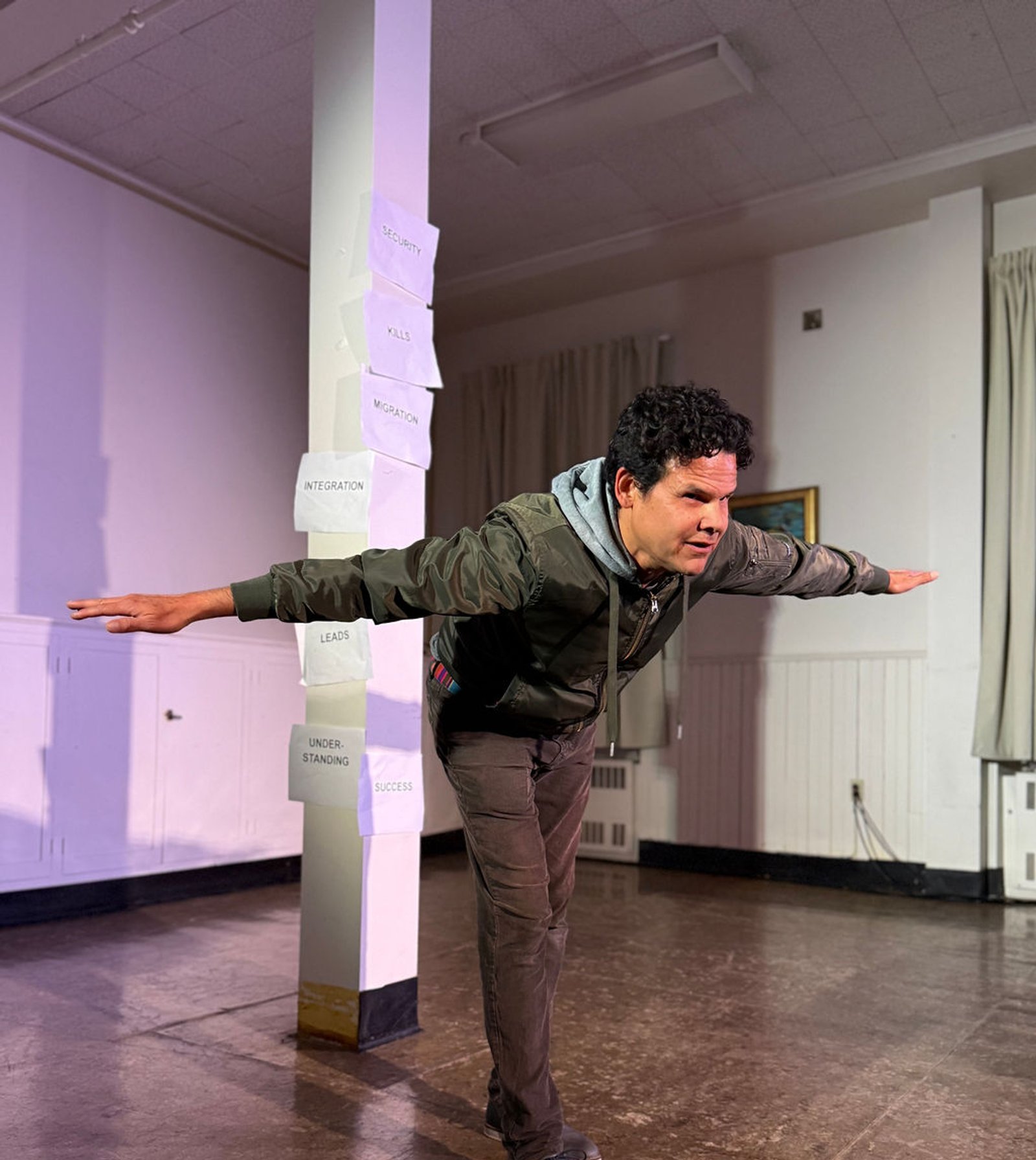
We are not just watching actors; we are seeing three people who know what it is like to leave a country behind, the struggle of navigating and adapting to cultural differences, the feeling of nostalgia, and the hope for belonging.
"Are you an immigrant?" is a question that may come from curiosity but is never without malice. By the end of the Yunta Clan collective’s Migratory Birds, you will hear it differently than when you arrived. The play begins with the audience gathered in the corridor outside of Teesri Duniya’s Rangshala Studio as if standing on a metro station platform, the familiar hum and screech of Montreal's underground trains in the background. In the world of the play, it is 7 a.m., that early hour when most metro riders are commuting to work while the rest of the city sleeps for a little longer. Among us are Cristina Alejandra Jiménez, Diego López, and Aurelio Mez, the migratory birds portraying a possible version of their own lives. We are then prompted to move from the platform into the room. The transition feels like starting a journey into someone else’s life and, despite the small space, happens seamlessly. Inside, the room is bare, hard chairs cramped together, which feels like its own statement on the story we were about to hear three times over.
Created and performed by the artists for Teesri Duniya's Backyard Theatre Festival, the play shares three different stories of Latin American migrants and their lives in Montreal. The protagonists kick off their stories first in French, then English, and finally Spanish, even though Spanish is the characters’ native language. This order says a lot about which languages the city prioritizes, setting up the play’s larger question of belonging and acceptance.
Inside, the room was bare, hard chairs cramped together, which felt like its own quiet statement on the story we were about to hear three times over.
The first tale is one of struggle. A woman from Colombia moves to Montreal in the hopes of finding the creative haven the city presents of itself: a place where artists can live as artists. Instead, she must take on various odd jobs just to get by, while her dreams remain unfulfilled. In one segment, she speaks with her mother on the phone and, to my surprise, switches from Spanish to English mid-sentence. Perhaps the swap is a reflection of where she is, as if conveying the belief that it is more important to be polite to strangers than to be comfortable with her own mother. She speaks about migratory birds, explaining that some fly to better grazing lands while others simply want to be free of the things a society decides they should be. The phrase that lingers is one she repeats across her monologue, never quite the same way twice: "How do you stop being poor in a country of rich people?" The first time, it lands with a pause, almost rhetorical. The second comes coated in sarcasm, but by the last time, there is nothing left in it but sadness. "How do you stop being poor in a country of rich people?" Eventually, it stops sounding like a question and starts sounding like an accusation, one aimed at an economic system that depends on the question staying unanswered.
The second story is about loss. A man from Peru arrives in Montreal with his dog and finds that his life is more comfortable with animals than with people. The most difficult part of his experience is the news which he receives from a distance — someone he knew has died — and the helplessness felt when grieving a person you are unable to be with. He was not there to say goodbye. What he has instead is the calculation of the years they were apart, a time which cannot be regained, no matter what happens for the rest of his life. The story also reflects the loss of a part of one's identity, a loss which may be more gradual for migrants than for people who have always lived in the place where they were born. For most migrants, people from their past do not know their present, and people from their present do not know their past; many remain in a state of limbo, in search of something they feel they may have lost.
The third anecdote is of hope, though it presents itself as a history lesson at times. A man from Tijuana links the histories of Tijuana, Las Vegas, and Montreal as if they all belong to the same restless family. In his telling, they do: three cities built on the same reputation for letting people live alternate lifestyles, reinvent themselves, and live by looser rules than the places they came from. His own father migrated too, so maybe the pull toward elsewhere runs in the blood rather than being a decision made fresh each time. He is the funniest of the three and at the same time the most unresolved, still trying to work out which version of himself belongs to which city.

Struggle, loss, and hope rarely arrive in anyone's life in order, and keeping these three stories separate rather than collating them into one narrative preserves their authenticity. These stories seem very real and are likely the writers' own migration stories, or versions of them, told by the people who lived them. We are not just watching actors; we are seeing three people who know what it is like to leave a country behind, the struggle of navigating and adapting to cultural differences, the feeling of nostalgia, and the hope for belonging. The acting itself felt raw and organic rather than rehearsed, and if the performances were occasionally uneven in the technical sense, that never got in the way of how much I believed them. The play ends with the three migratory birds coming together, laughing at the question they have all heard from someone born here: "Are you an immigrant?" What was once possibly an insult becomes a joke they share, showing it no longer hurts them.
As I argue in my review of Wine & Halva, the distinction between "expat" and "immigrant" is not merely a linguistic coincidence but a legacy of colonialism, one that determines whether someone is seen as adventurous or suspicious when they take the same journey. Migratory Birds reaches the same conclusion from a different perspective, less concerned with which term is used and more focused on why the question is asked, and by whom.
"How do you stop being poor in a country of rich people?"
Migratory Birds does not need to make its political stance explicit, since history itself carries out that function; this land was home to people long before any of the dominant languages spoken onstage arrived, and every single person who is not Indigenous to this territory has, somewhere in their family's history, been a migrant too. The play does not let anyone stand outside that question just because their accent has had more time to soften. And yet the standards stay uneven. A new immigrant is expected to be exceptional simply to be considered acceptable, as though ordinary belonging were a privilege reserved for people who never had to prove they deserved it, despite their presence in a country built entirely by people who came from somewhere else, whether one generation ago or ten.
I left Rangshala Studio thinking about my own answer to that question, and how strange it is to have to keep proving where you belong. Migratory Birds will resonate with anyone who has had to explain, more than once, where they are really from. Teesri Duniya is doing a great job making room for stories this city does not always know it needs until it hears them. Watching this one land with the audience left me genuinely hopeful about what a more diverse Montreal theatre scene could look like. I am already looking forward to whatever the Backyard Festival brings next, and to hearing from these three migratory birds again, whether on this stage or another.
“Migratory Birds” by Cristina Alejandra Jiménez, Diego López, and Aurelio Mez ran from September 17 to 20, 2026, as part of Teesri Duniya Theatre's Backyard Theatre Festival. The event took place at Rangshala Studio, Cité-des-Hospitalières, 251 av. des Pins Ouest.
 About Ankush
Ankush Lamba is an Indian-Canadian writer, poet, and columnist based in Montreal. An HEC Montreal MBA graduate working in tech marketing, he explores migration, identity, and belonging. Having travelled to over 50 countries, he brings a global lens to his work. A QWF member, his writing appears in the Montreal Gazette and beyond.
Read moreComments
No comments yet.
Be the first to speak into the void.