
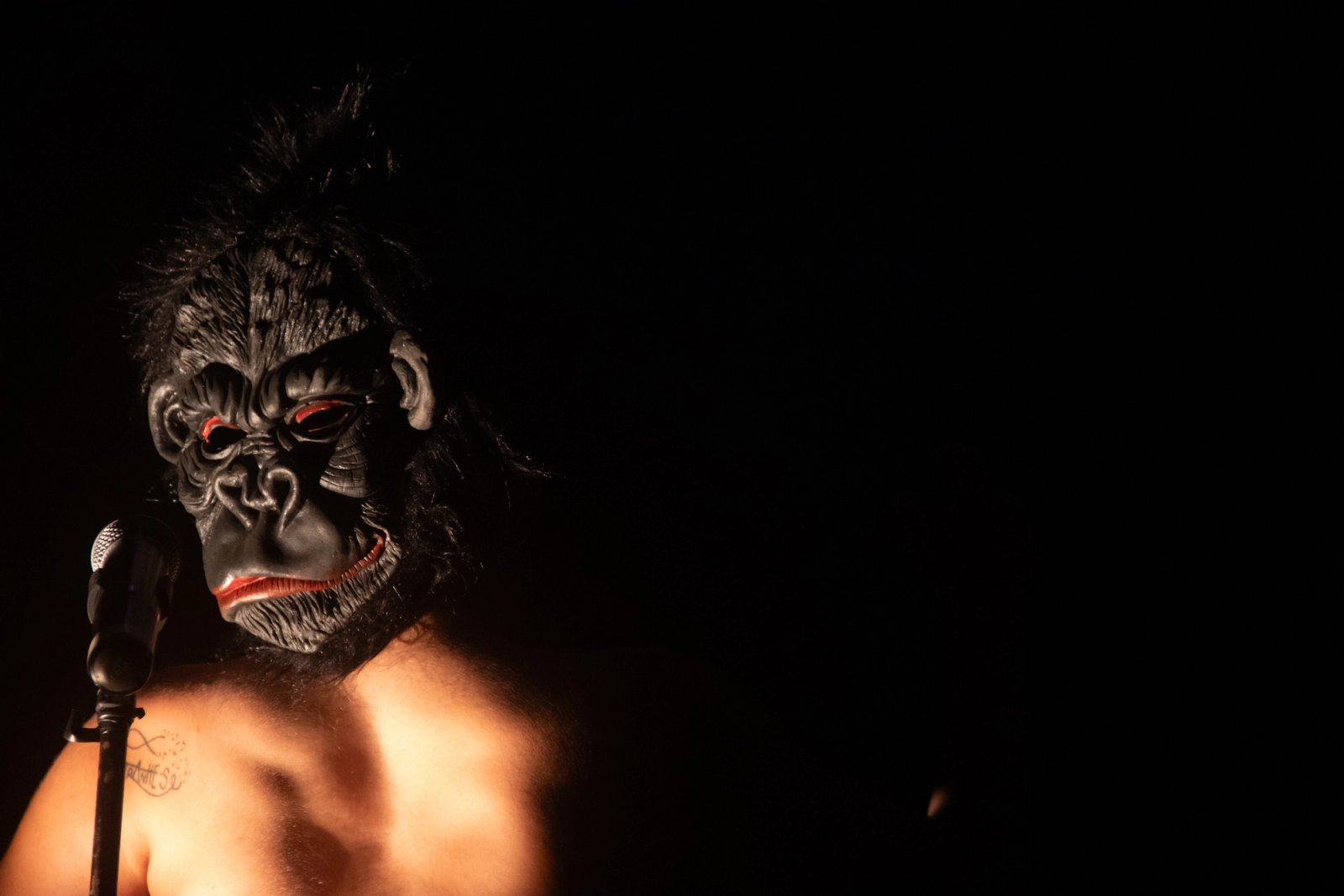
This Brazilian show is a dialectic and dialogic exploration between both audience and performer. It begs to discuss communally how accessibility can serve as a motor for creativity.
When faced with an identity checkbox, pretend to read it diagonally, grab a pen, cover it in curse word doodles, crumple it aggressively in a ball making a fist, burn it with a gold lighter and blow a kiss to its ashes. That is, in short, what experiencing Jéssica Teixeira’s Monga feels like. This Brazilian show is a dialectic and dialogic exploration between both audience and performer. It begs to discuss communally how accessibility can serve as a motor for creativity. Fourthwall-less and raw, the performance blended theatre, concert, cabaret, and storytelling effortlessly, wrapping us in a gritty blanket. What makes Monga special is its dedication to accessibility. Deaf LSQ performance artists took turns standing on pedestals, French LSQ interpreters sat upstage translating everything happening on stage, subtitles were projected on three different screens, as well as a detailed description was verbalized at the start of the show by the performer herself. After the show, we stood by the side of the venue sheltered from the pouring rain and exchanged a few thoughts on what we had just seen. Here is a snippet of the conversation that took place between DIS writers Nikita Chigoho and Azin Mohammadi.

Q (Azin): Monga stands as a rebel. It lies outside the norms of conventional theatre structure and places itself on the counter-cultural end. What became clear to you right from the beginning of the show? What struck you as being an urgent component?
A (Nikita) : There was a certain sense that something had to be said but we meandered along the way. The starting music was ominous and the stage was cramped. As the audience walked into the theater we saw a set with a soft box, a camera, tables filled with trays of shot glasses and a two-person band behind it all. All of these objects made the stage look quite small. But throughout the performance the stage felt like it became bigger and Jéssica was able to move around more and talk to people, with uneven success. At the end the stage had gotten even bigger as some objects were removed, and as band members began walking around, even banging under the platform where the audience sat. In the end we are left perplexed. This urgency was perhaps not for the audience but for the artist to release many tangled thoughts on colonialism, womanhood and art.
Q (Nikita) : I really liked your reference to urgency. There is a real preoccupation with time, like she felt like she was running out. How do you think she dealt with the concept of time within the show?
A (Azin) : I perceived the show as a celebration of life and death. It seemed that Teixeira was not anxious about the passing of time but was somehow simultaneously hyper aware of it. This became evident, from the way she basked in every moment she was chatting up with the audience, from her movements on stage and from overall pacing of the show. Based on the lyrics of the songs sung by Teixeira and the narrative around death, life, and existence, my impression was that we were meant to feel that this was our last night on earth: To celebrate art and the absurdity of being by dancing together, witnessing one another’s vulnerability, laughing at the silly Gorilla mask and downing caçhaca shots. Conceptually, these themes related to time were dealt with in a very direct manner, in that they were woven into the various segments of the performance. She named, explicitly, facts and feelings about death, time and sickness. There was no beating around the bush…well not the figurative kind at least.

Q (Azin) : Could you describe how you felt observing the show as a critic as opposed to watching it as a spectator? What made your position different in this particular experience?
A (Nikita) : I was resistant to absorb the amount of information presented at first. As a cultural commentator I am always looking for themes to emerge and to understand the mechanics of a performance, in order to provide a helpful review. But this piece was too frenzied, so I had to lock in.
When I finally gave up and retreated back into the position of a spectator, I was enjoying myself more. The experimental approach was so dizzying that I had no choice but to immerse myself and leave my notebook behind, a welcome change of pace. Many theatrical presentations are becoming formulaic, with expected beats and plot lines. But here, there is no time for real-time analysis. The singing, the storytelling, the weird camera set-up, the cachaça shot, the dance party! I was constantly surprised.
Q (Nikita) : This was clearly an experimental performance that teetered between anarchist freedom and disorganized execution. Do you think Monga was successful to avoid unintentional confusion?
A (Azin) : Wow, it took me a second to understand what you mean by avoiding unintentional confusion. My brain is recovering from a few somersaults, give me a minute… I don’t think Monga gave a shit about linearity and audience comprehension. So I think it succeeded in intentionally confusing us. With that said, I disagree with those who would say that it was completely disorganized, there was a clear introduction where Teixeira described every single detail on stage and welcomed the spectators with an opening song. There was also a most evident-on-the-nose cathartic conclusion in which there was a literal cacophony consisting of musical elements, screams, sounds of banging objects and the stage manager’s drill protruding from underneath the platform.

Q (Azin) : In the context of this work, do you feel there is something to be said about nudity versus subversion? To this day, there is major discord regarding the presence of nudity on stage. In what ways did nudity elevate or complexify the performance?
A (Nikita) : It was something that anchored me through the performance. The nudity felt very random at first; I was hoping for an explanation or some symbolism. I never got it, which perhaps was the point. I interpreted the nudity as a sort of capitulation to a certain voyeurism that disabled people are too often subjected to. We see that Jéssica Texeira’s body is different but we never get an explanation. I wanted to know more about her, her life and especially her personal connection to Julia Pastrana's life; maybe this was an occasion to examine my desire to see a different body politicize their existence. It must be exhausting to have to justify her appearance, and I am glad she didn't feel the need to. The nudity never felt vulnerable even when Jéssica was being filmed. Even if she was, there was simply too much happening to really take it in.
Q (Nikita) : A crucial element, the story of Julia Pastrana was brought up in the middle of the show, recontextualizing it entirely. What do you think about Pastrana’s story in relation to the performance?
A (Azin) : Julia Pastrana, an indigenous 19th century Mexican artist, was labelled a freak and a monster because of her hypertrichosis condition, a rare disease which covered her body in hair and caused a protruding jaw. I suppose the performer of this show was deeply inspired by Pastrana due to the similar experiences she had with the arts industry and perhaps even the world. In terms of its connection to the theatrical choices, we are confronted to it right off the bat with the Gorilla mask. We learn through monologues and visual elements about Pastrana’s biography and how she was called the “Monkey woman” and are consequently invited to question the idea of the instrumentalization of disabled bodies as objects of entertainment, exploitation and mockery. Teixeira doesn’t talk about her own condition but is naked and puts forth her body as evidence. As such, we can say that the performance was also an homage to Pastrana and to all bodies perceived as "divergent".
Monga was presented on Friday May 29th 2026 at the Espace Libre by Festival TransAmériques. For upcoming editions and programming, visit fta.ca.
 About Nikita
Nikita is a writer and creative based in Montreal. He experience in facilitator and community work has led her to launch Blackout productions, where she organize events for BIPOC creatives around the city. A member of the Quebec Writers Foundation, she has been featured in the Pit Periodical and other publications.
Read more About Azin
Azin Mohammadi is a librarian, performer, and writer. She was born in 1993 in Iran before moving permanently to Montreal at the age of four. Mohammadi holds a BFA from Concordia University as well as a Master's of Information Studies from Université de Montréal. Her performance and playwriting practices were developed autonomously and alongside different companies, collectives, residencies and festivals locally and internationally.
Read moreComments
No comments yet.
Be the first to speak into the void.