
Although I would’ve liked to see the political more explicitly woven into the rest of the show, Onde still offers the public a valuable moment to reflect and ask difficult questions: What’s happening to our friendships?
When I receive an invitation to a performance about friendship, I’m filled with both curiosity and a sinking feeling. It feels like receiving a call to the bedside of a beloved who’s extremely ill. Friendship in the Western world is bent out of shape. The intimacy of mutual understanding and reciprocity often feels rare, shallow, short-lived. I feel a tide of grief rising about some of the fractured friendships in my own life as I bike to La Sala Rossa on an obscenely warm October day to see Onde, a show in the 15th anniversary lineup of one of Montreal's most spectacular and underrated festivals—Phénomena.
A crowd of about 50 is gathering in the venue's small foyer and spilling down the steps. Blue and silver shards the size of large kitchen knives dangle above our heads from several small mobiles, glinting in the sunlight pouring in from a window. The rhythm of salty ocean water thumping up against a shore sloshes into the hall through a small speaker. Onde’s artistic creators, our narrative guides on this sound-based journey, emerge wearing blue: Milena Buziak, Natalie Norma Fella, Giulia Tollis, and Alessandro Mercurio (replacing co-creator replacing Marie-Hélène Massy Emond for this iteration of the show at Phénomena). In an almost ritualized procession, we slowly, quietly move upstairs where we spend about an hour listening to real testimonies of friendship that the artists have carefully curated from across Canada, France, and Italy.

Chairs arranged in a semi-circle face a wall upon which hang many archived letters, postcards, photos, and drawings. Through short skits, audio recordings, and transcripts of recorded conversations read aloud, the artists share moving stories of friendship. Some are friendships formed in the boundless worlds of childhood imagination, others formed in the solitude of old age, and some in between.
Among the most moving, for me, is an exchange of letters between two friends, one of whom seems to have abruptly “disappeared.” The artists invite two audience members to sit in chairs facing one another, each with a stack of envelopes at their sides. They take turns opening one envelope after another and reading their contents to the other. Their recitations are slow and heartfelt. The language overflows with vulnerabilities: disappointment, longing, warmth, grief. Some letters were never sent.
I notice a kind of uneasy satisfaction arising in me as I listen. Two lives, once connected yet now long dispersed, are suddenly collapsed into two warm bodies just an arm's length apart, gazing into one another’s eyes throughout the performance. Imagining such a reunion, after so much irretrievable time and space, feels like a kind of guilty fantasy.
Later in the show, a character from a different time and place demands of a lost friend, “What happened? Why didn’t we talk about it?” The questions remain unanswered and haunt me long after the show ends.
The materiality of typed or handwritten letters and other texts makes me feel warm and fuzzy, but also nostalgic. At first, the archive of friendships the artists have assembled feels disjointed from our current digital reality. It’s not clear whether the artists, most of whom appear comfortably older than Gen Z, sought to revive these practices or mourn their end. However, their take on digital technology’s impact on social connection becomes strikingly clear in the final act.

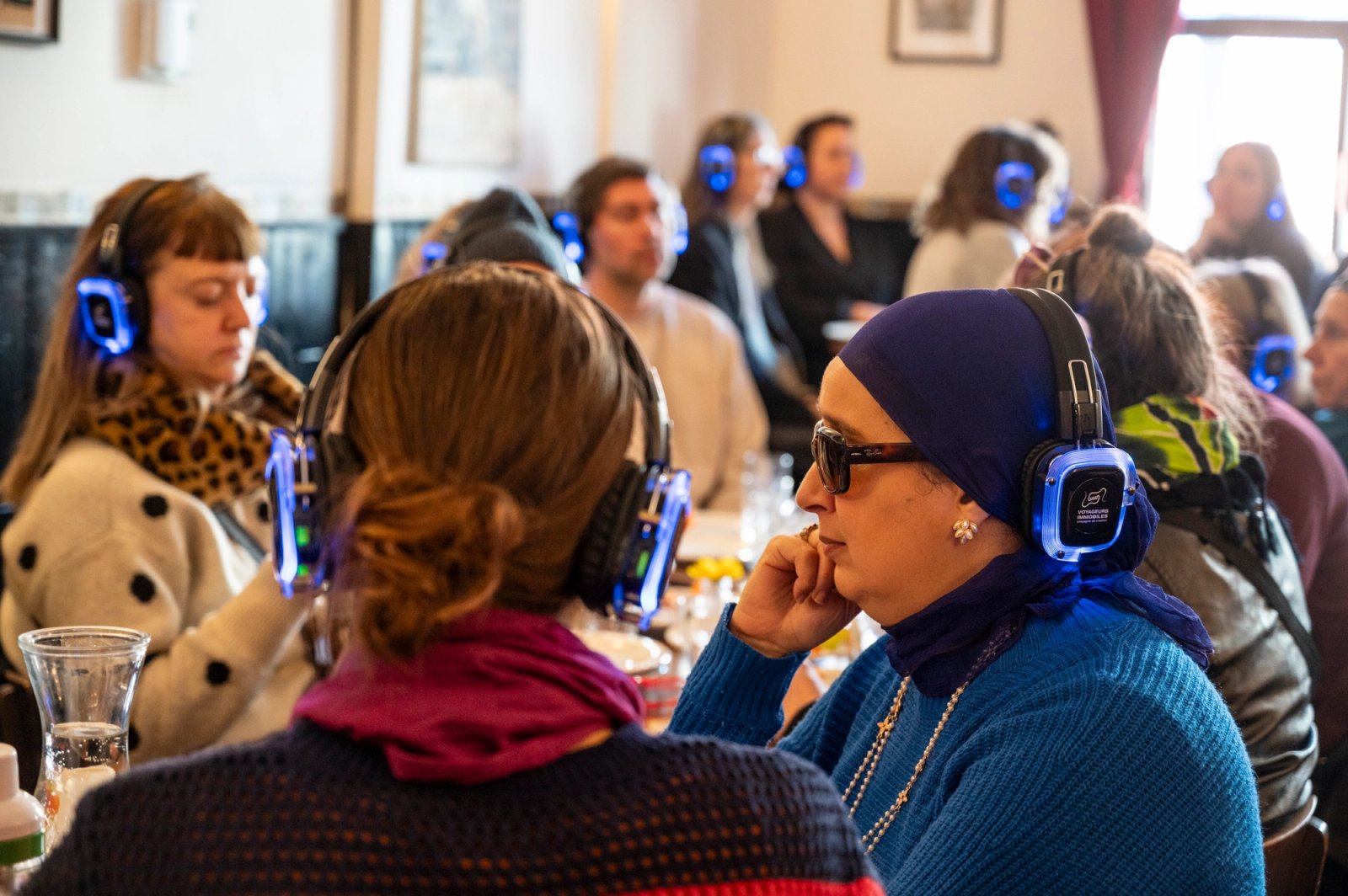
The audience is moved into the dining room of Sala Rossa’s restaurant. Stacks of plates are handed out at the entrance, and we’re asked to help set the tables for people to sit in groups of four. The mood is cheerful and communal, that is, until each of us is handed over-ear headphones. In the eerie style of a silent disco, the room goes quiet as a recording is broadcast to our individual headsets: it’s a conversation between elders reflecting on a whole lifetime of friendship, and the solitude and loneliness they experience now. No one in the room seems to know where to rest their gaze. Some people close their eyes. Most avoid eye contact. The effect is chilling and all too familiar.
I’m a bit less convinced by the central metaphor and title of the show. Onde is the French word for “wave.” In the show, waves are used as a metaphor to describe the way it can feel like time and space undulate within a friendship. The metaphor suggests such intimacies follow a kind of natural rhythm of closeness and distance, just as the moon naturally sets the ebb and flow of the ocean’s tides. While that may be true within individual friendships, I find nothing natural about the massive friendship recession across Western societies, which comes with devastating consequences.
Earlier this year, Teesri Duniya Theatre’s show Wine & Halva framed friendship as fundamentally political and deeply urgent in the face of fascism. In the final act, Onde manages to bridge the personal and political. Although I would’ve liked to see the political more explicitly woven into the rest of the show, Onde still offers the public a valuable moment to reflect and ask difficult questions: What’s happening to our friendships? Why don’t we go ahead and talk about it? We need many more interventions on the topic in Montreal’s performing arts.
Onde was performed on October 17 and 18, 2026 at La Sala Rossa as part of Phénomena 2026. You can find more information about the show here.
 About Danielle
Danielle is a writer and editor based in Tiohtià:ke.
Read moreComments
No comments yet.
Be the first to speak into the void.