
Maybe they’ve got a more nuanced take on killer cops, reproductive rights, and intersectionality. If so, I certainly didn’t catch it.
One Too Many tells an unlikely story about four women and one man. It’s billed as an “absurd feminist comedy.” I was looking forward to seeing a female majority cast grapple with the difficult topics of “bodies” and “choice,” but by the end I felt it came off as absurd in ways that were not intended.
Overall, the plot is neat. Anna (Naomi Wark) and Jake (Tyler Dezso)–a heterosexual couple–move into a new home. He wants kids. She doesn’t. He insists. She kicks him out. In his devastation, he stumbles into the lives–and beds–of three other women, who he doesn’t realize are all connected to his fiance, too. Of course, it all comes out in the end in spectacular fashion.
These kinds of convoluted narratives risk losing the audience, especially when crunched into 40 minutes. Yet, poignant performances from each actor succeed in building relational clarity between robust characters, whose quirks keep the audience laughing. Each of the women–skillfully played by Naomi Wark, Sana Buchanan Hutchinson, Noriane Girard, and Lydia Larabée–tells stories about how they've dealt with life’s unexpected turns. A death in the family. A teenage pregnancy. And…accidently shooting someone to death as a police officer?
Hold up.
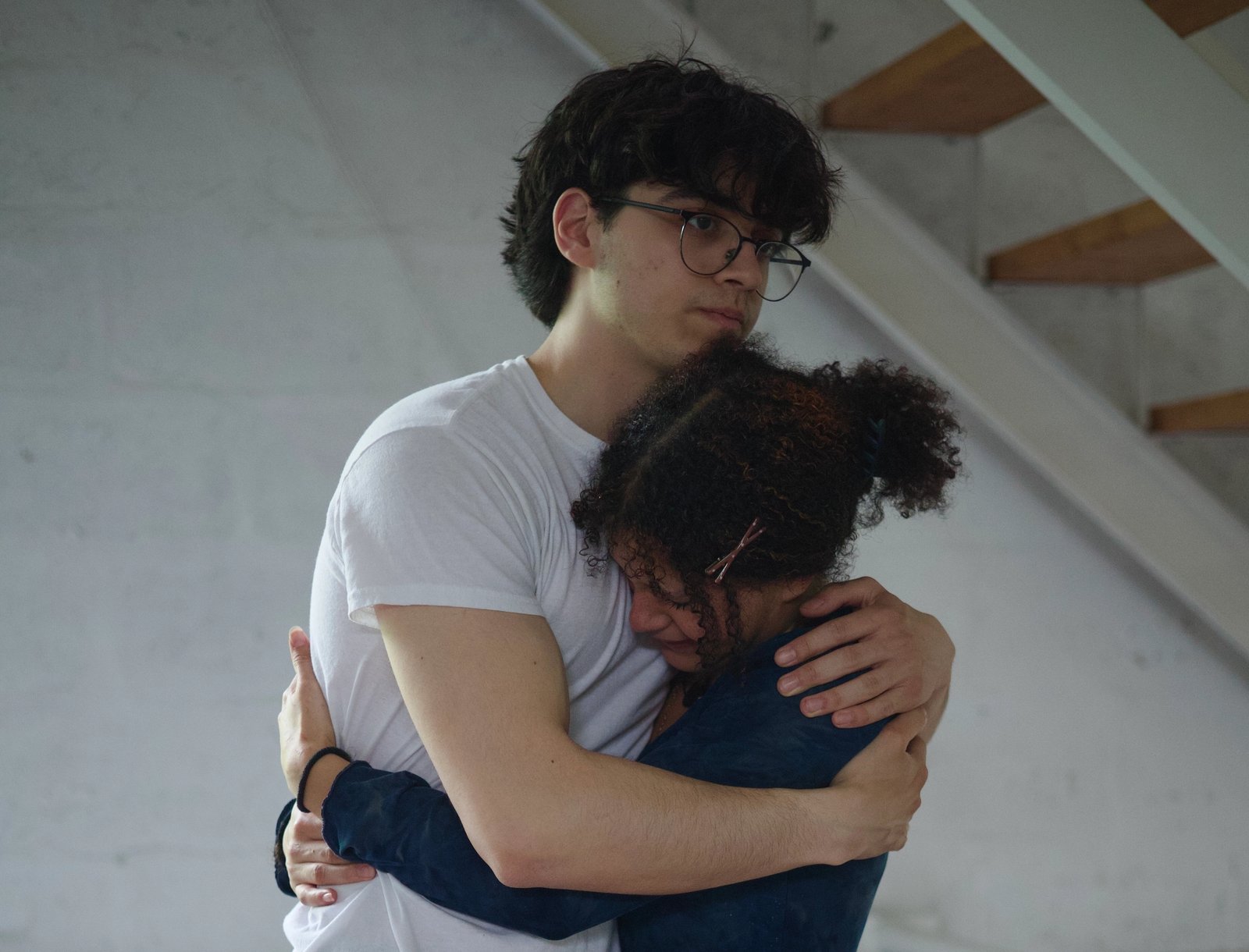
There’s this one scene, very early on. A woman named Sandy (Sana Buchanan Hutchinson) finds Jake in shambles after separating from his fiance. She coddles and coaxes the manchild into crying on her shoulder. And then, she cries on his. Sandy admits to being the police officer who shot and killed someone during a bar fight who “wasn’t even the aggressor.”
Jake consoles her. “You’re not a bad person…You don’t have to be alone,” he says, taking her into his arms. Much later, Anna meets Sandy at church (another jarring, unresolved detail), and supports her in getting an abortion in a way that resembles feminist solidarity.
At best, Jake’s sympathy for a killer cop could be read as the play’s overwrought way of cementing his absurdly bad character. But Sandy sticks around as one of the female protagonists. At worst, I read it as hinting at some kind of parallel between Sandy “accidentally” shooting someone to death, and unexpectedly becoming pregnant. As in, both were just an understandable mistake. As in, conflating a structural failure (police violence) with a personal accident.
Maybe that’s not what they meant. Maybe they’ve got a more nuanced take on killer cops, reproductive rights, and intersectionality. If so, I certainly didn’t catch it. The show never clarifies or works out Sandy’s situation further. Instead, it careens forward with all four women’s characters revolving around Jake, which in itself ensures the show’s failure on the basic feminist Bechdel Test.
Jake’s transformation from a familiar, icky manchild into a cartoonish man obsessed with spreading his seed feels abrupt. The dramatic, bloody ending invokes an ancient feminist trope that should feel cathartic, but that in my view they haven’t earned the right to use. Up to that point, I’d been more concerned about the toxic heteronormativity in which all the female characters participate, than Jake striking out as the singular villain of the show. Not to mention the glaring, unresolved killer cop tears thread. So much nuance and complexity are lost that the ending feels like a cheap trick.
A lot of the well executed staging and performative energy goes into “you can’t sit with us” comedic drama, which is totally fair game at Fringe. But when you also toss in a grenade or two, like religious oppression and police violence (let me not get started on consent), it feels tone deaf. Along with stage manager and production designer Eleftheria Lazaridis, Montreal-based LLOTS Productions delivers a debut with some potential, albeit convoluted on critical and pressing issues they’d do well to handle more delicately in the future.

One Too Many was presented as a part of Montreal Fringe Festival’s 2026 programming at White Wall Studio. As of this writing, the following performances remain:
Thursday, June 18 at 19h30
Saturday, June 20 at 21h00
You can find more information here.
 About Danielle
Danielle is a writer and editor based in Tiohtià:ke.
Read moreComments
No comments yet.
Be the first to speak into the void.