
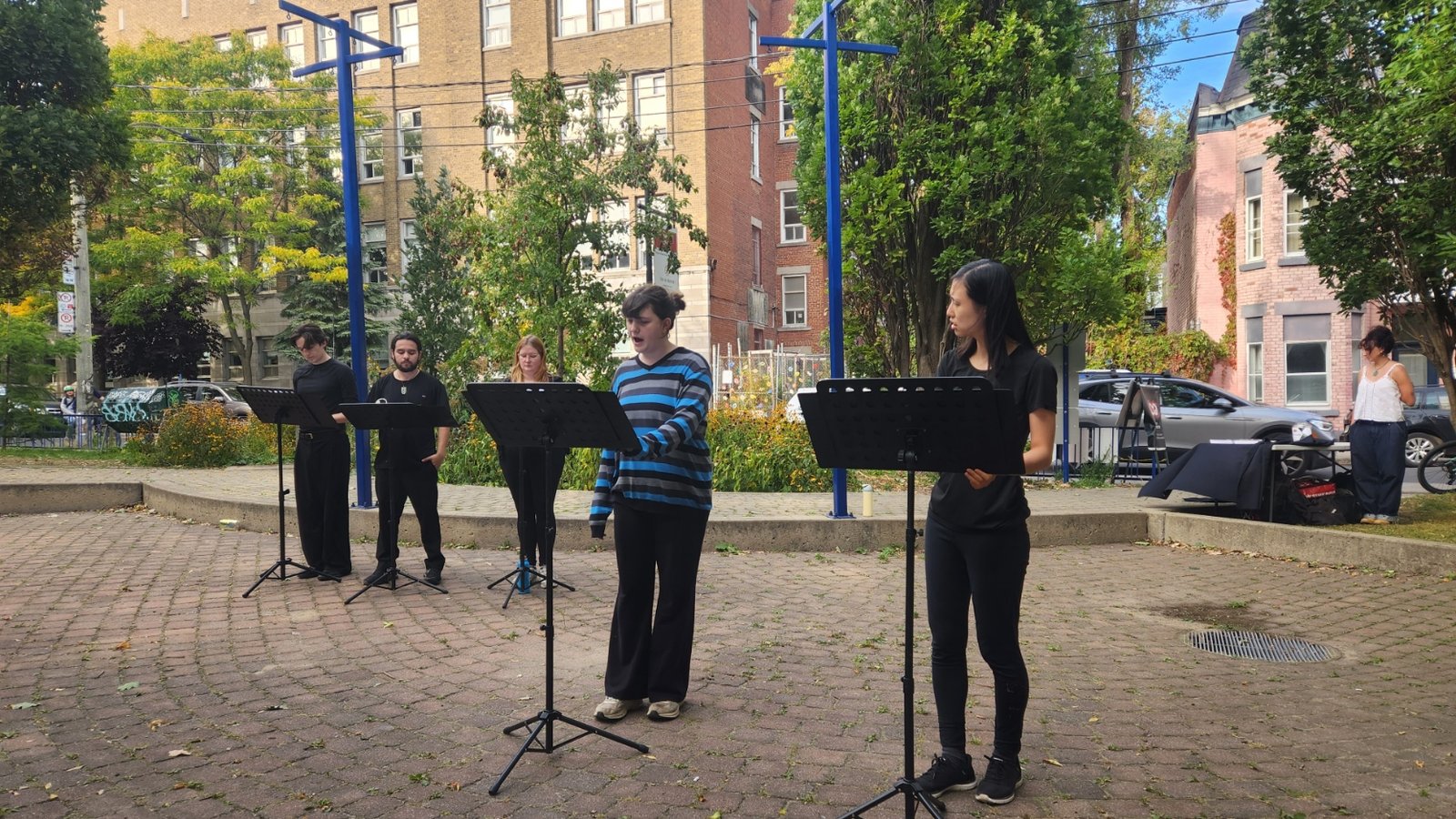
This year, the scripts showcased at Park ‘N Play reeked of gender, desire, and freedom. Tuned into the rapidly growing right-wing sensations, violence against women, and late-stage capitalism, the writers, some as young as 14 years old, have produced work that investigates the conditions of their lives and anxieties against this backdrop of violence.
Infinithéâtre hosts Park ‘N Play, an annual open-air reading series of plays shortlisted in their youth playwriting competition, WRITE NOW! This year’s 5 shortlisted plays were brought to life by an ensemble of young actors: Sinead Chapdelaine (the program’s winner in 2021!), Gregory Ryan, Alice Shuang Wu, Olivia Kearvell-Jobin, and Joshua Bilbao, under the direction of Madeline Scovil and Zach Fraser (Infinithéâtre’s Artistic Director).
Happily Ever After by Violette Kent & Anouk Lemons-Winter
These youths’ first time dabbling in the art of playwriting explored what I call fanfiction- or romantasy-inspired heterosexual relationships. Mysterious circumstances lead to the meeting of two young people in a bookstore. The girl is a bookworm, and the boy learns from her about the joy of reading. They slowly fall in love and call each other cheesy nicknames, but they are ultimately separated by a force beyond their control.
Thinking back to the widely read Substack post “Sold to One Direction: a Very Deep Dive,” I chew on the young desire to write characters deep in gender tropes. Sithara Ranasinghe, the post’s writer, calls this a response to “gendered fears” and says, “teenage girls aren’t deaf to all the cultural messaging around them that men are dangerous and full of violent, criminal impulses … But what can you do with that information to feel like you have any sense of agency? Well, you can explore these difficult ideas safely in the world of fanfic.” Now, Happily Ever After is far from a One Direction fanfiction. In fact, it has nothing to do with that. But what stands out to me from this story of a girl wearing babydoll dresses, deep in the world of books, who meets a mysterious boy who listens to her, takes on her hobbies and interests, and ultimately falls in love with her, is the same kind of gendered fear and gendered desire: a desire to be valued, a desire to be respected, and a desire to be safe expressing yourself as a girl.
Me, or We? by Marley Kamaei & Jack Schaffhauser
Developed from a writing exercise in the duo’s acting class, Me, or We? is an exercise in character development, conflict, and an unearthing of the uneven, gender-based division of domestic labour. The story follows a brother and sister duo who come together in the last weeks of their mother’s life. The mother, sick with terminal cancer, has been in the care of her youngest daughter throughout her treatment. When we meet the siblings, the prodigal son (and Mom’s favourite) has just returned home from medical school. What immediately stands out in the script is the dismissal of the sister’s labour, pain, and life aspirations. Her brother ridicules her social life, minimizes her months of caretaking, and dismisses her repeated cries for help. From their argument, we learn that this has been a long-standing pattern in the family dynamic. The story moves on towards its central conflict, but I would like to pause here in this carefully laid-out exposition. Wrapped in layers of discussion on academic success and failure, Me, or We? presents us with another young woman pushed to the extremes, as she is left alone with mountains of feminized labour. She is expected to take care of the elder of the family and their home, but she also has to deal with expectations that come with being a “modern” woman: have friends, have aspirations, have an academic career, and succeed at all of the above with no support. She struggles to be heard, loved, accepted, and free from these unrealistic expectations. On a broader level, the text deals with the desire to be free from misogyny and the expectation to become “a successful adult,” a desire that I suspect is also integral in the lives of Kamaei, Schaffhauser, and their peers.
Harbinger by Vivian Mills
“This is a crisis,” says Vivian Mills, in her dystopian, adventure-filled script. Two girls, feeling suffocated by the constant wave of [bad] news, decide to run away, and they die trying. Mills has put into words and images what a lot of WASP or North American youth might go through these days; bombarded by news of “the end of the world” (climate catastrophe, genocide, war, and the rise of fascism being a few subjects on this too-long list), they feel helpless, powerless, and scared. Their aspirations and futures are threatened. This fear and threat lead these youth, who are far from the centre of any of these conflicts, towards a strong desire to change the conditions of their lives by their own hands. “You have to get up and save yourself. So get up,” one of them says. For the two girls in Harbinger, saving themselves means running away into deep nature. They prepare for their departure for months, only to be found frozen to death shortly after. Their tragic end, broadcast by the same news channels that brought the youth their daily dose of bad news, is perhaps another reiteration of the desperate times we are living in: “It’s not like we can do anything that’ll actually matter.”
Rebirth by Sébastien Cimpaye
Rebirth is a comedic interpretation of a young person’s fear of not being good at being an adult. Buddy, the main character, is stuck at their own surprise birthday party, reliving the event in an endless loop. Every time the loop restarts, they seem to be younger, and in every loop they find a baby on the couch! Confused, Buddy repeatedly asks their friends for an explanation. Their responses are always cryptic and unhelpful, exacerbating Buddy’s panic and confusion. By the time we pass Buddy’s fifth birthday, the audience is laughing their heads off. Actor Joshua Bilbao’s comedic timing, along with the ensemble’s dedication to their roles as oracle-adjacent friends, brings forth the humour hidden in Sébastien Cimpaye’s script. The mystery of the birthday loop, and the four loose babies, is finally revealed by the oracle-friends right before Buddy turns into a baby themself. “So you think it’s too hard to take care of a baby?” they ask Buddy. “Are you sure you understand what you’re doing?” It turns out that this is a punishment for Buddy, who is still acting like a baby at their big age of 20! They are stripped of their adult privileges, as they literally turn into a baby. Cimpaye, the runner-up for WRITE NOW! 2026 and a playwright shortlisted in 2025, said he had not expected the audience to find the script as funny as they did. The comedic direction of the reading only helped the fundamental fears and questions that Cimpaye is exploring in his text land sharper: what if I’m not good enough? What does it mean to grow up? What kind of world am I stepping into?
They Liked Us Better When We Had No Control - Testimonials of Girlhood by Mai DaSilva
A chorus of angry girls and young women talk about womanhood. Beauty culture, rape culture, modesty culture. Things we endure every moment, awake or not, from when we are born until we die. Hair, nails, body, clothes, diet, tits, hips, face, lips, groping, grooming, neglect, abuse, rape. One of them wants to shave her hair, as if it would free her from the prisons of beauty and femininity. One of them wants to raise her voice and be taken seriously about being abused. One of them wants to be a person instead of an object of sexual desire. She says, “I feel suffocated by the idea of being observed”. All of them want to just be. Be free, free, free. “My body doesn’t feel like mine,” one of them cries. Mai DaSilva, this year’s winner of WRITE NOW! and a playwright shortlisted in both 2023 and 2024, has written one of the most theatrical texts of the reading. With a clear understanding of the distinct qualities of a dramatic text, weaving tension through its characters and the pacing of their speech, Mai DaSilva has created a promising piece of theatre and a sharp critique of patriarchy, not yet dulled by the polite tactfulness of adulthood.
Park ‘N Play 2026, Infinithéâtre’s annual free open-air reading series, took place on September 26th in Parc Drolet Rachel, in partnership with Journées de la Culture.
 About Banafsheh
Banafsheh Hassani بنفشه حسنی is an Iranian feminist theatre artist based in Montreal. Their passion and belief in the value of cultural criticism and the significance of loud racialized voices led to the creation of DIS in 2026.
Read moreComments
No comments yet.
Be the first to speak into the void.