
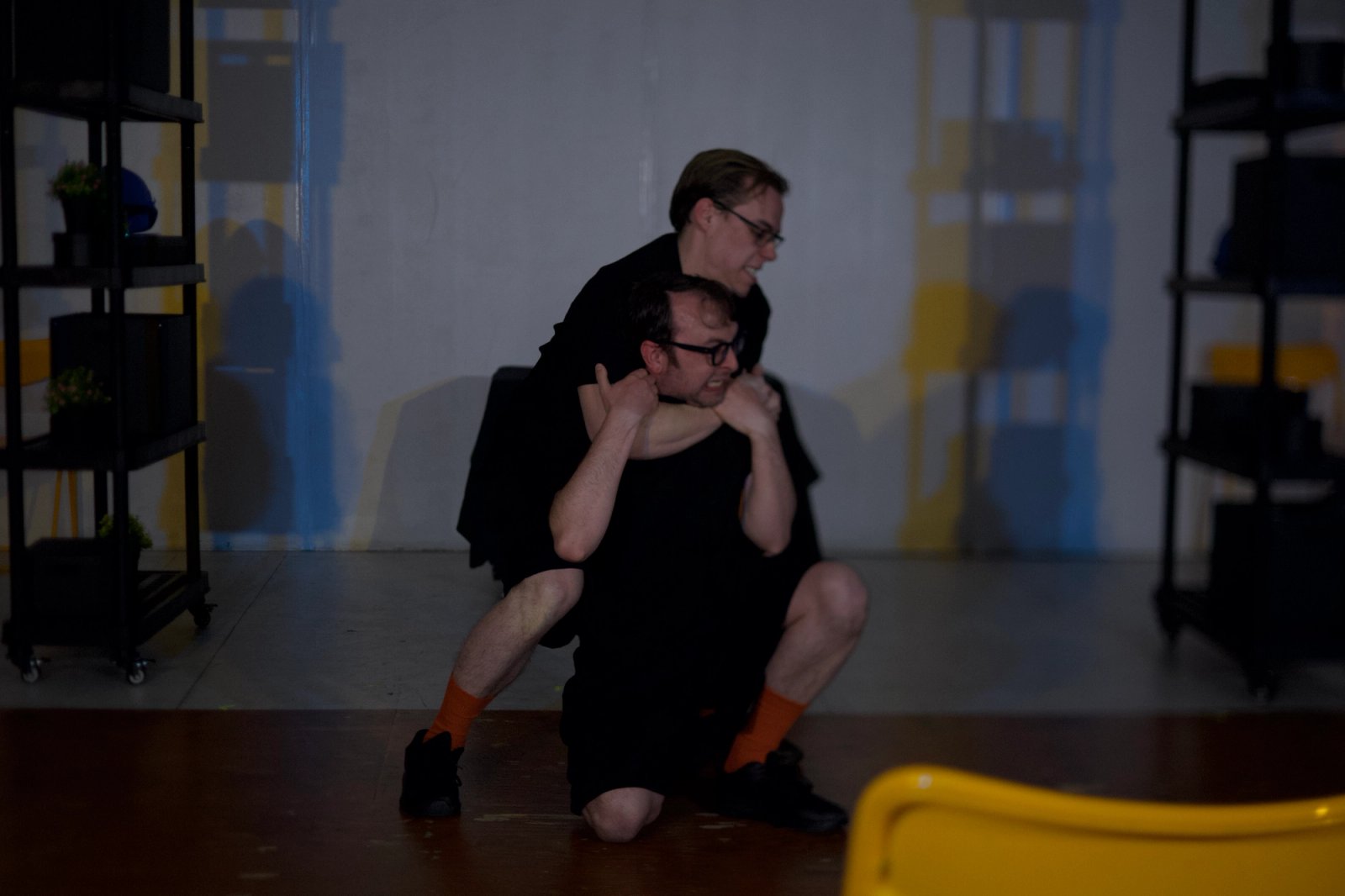
Bunny Best died the way she lived, loudly, at a Pride parade, and mostly on her own terms. How her two sons grapple with her death is where 'The Best Brothers' begins.
Bunny Best died the way she lived, loudly, at a Pride parade, and mostly on her own terms. How her two sons grapple with her death is where 'The Best Brothers' begins. But the question sitting at the heart of 'The Best Brothers' is more complicated than the absolute act of death: why do people insist on grieving the way we are told to? And what happens when two people who grew up in the same house, with the same parent(s), have absolutely no agreement on the answer?
Written by Daniel MacIvor and presented as the inaugural production of Born on a Raft Theatre, a new Montreal company producing work by and starring queer people, 'The Best Brothers' was performed at White Wall Studio as the Quebec debut of a play that has toured across Canada. The premise is darkly comic: Bunny Best, a free-spirited woman, dies in an unusual accident at a Pride parade, crushed by a drag queen named Pina Colada. Her two sons, Kyle and Hamilton, now have to arrange her funeral and write her obituary while trying to find common ground on what to do with Enzo, her Italian greyhound, who may have been the actual love of her life.

Kyle is gay and slightly chaotic; he wants to celebrate his mother and find some joy in this sudden surprise that life has thrown at him. Hamilton is straight and quietly furious, not just at his brother, but at the fact that Bunny was at that pride parade at all, because she was a proud mother to her gay son, Kyle. The resentment for perhaps not being the favourite son had been eating up Hamilton long before Bunny died. Grief allowed him to channel his trauma and indirectly blame his brother for something Kyle was not at all responsible for.
Thom Niles and Sam Beaton are compelling throughout the play as Kyle and Hamilton, respectively. Both are Montreal-based actors with strong local roots, having performed at various festivals. Before the play even begins, the two actors are already on stage, visible behind shelves of plants, sitting in orange chairs, busy with something quiet and private. It seems like a conscious directorial choice by Trevor Barrette, and tells you immediately that this is not a play that will pretend the performers don't exist between scenes.
The set moves with the actors. Plants get shifted from shelf to shelf as the brothers transition between monologues, and the orange chairs become the fixed point around which everything else revolves. The production gets most interesting in the scenes where each brother steps into Bunny's memories and inhabits her. Hamilton conjures a version of their mother that mirrors his own anxieties and possible judgements of her lifestyle, while Kyle remembers someone more adventurous and alive. I was never quite sure whether I was watching the mother or perhaps each brother's perception of her. That ambiguity is where the play captivates the audience.
Bunny Best dying at a Pride Parade is not just darkly comic, but almost appropriate. And Kyle, knowing how to celebrate her rather than mourn her, is not a character quirk but a queer cultural inheritance.
The dark humour is contagious; the crowd was laughing throughout. But underneath all the banter surfaced something genuinely painful: the way siblings can sometimes hold each other responsible for things neither of them can control. Different people can have different timelines for processing grief, and often for reasons the other person doesn't know. Judging someone else's timeline is easy. Understanding why theirs is different from yours is the harder thing. But what the play demands is an explanation of why we have a script for grief at all. We are taught that loss looks a certain way: sombre clothing and a particular sequence of rituals that signal to the world that we are taking death seriously. Hamilton lives inside that script, but Kyle does not. And the play is clearly more curious about Kyle's approach, without dismissing Hamilton's pain.
There is a reason Kyle's approach feels more instinctive than extreme, and it has everything to do with the queer experience of loss. Queer communities have never had straightforward access to the conventional grief script, historically denied the right to mourn publicly the people they loved. So they built something else: vigils that became celebrations and memorials that became acts of resistance. Pride itself began as grief, sparked by the Stonewall riots and carried forward by queer communities who refused to be quiet or invisible. Bunny Best dying at a Pride Parade is not just darkly comic, but almost appropriate. And Kyle, knowing how to celebrate her rather than mourn her, is not a character quirk but a queer cultural inheritance.
Socially, we tend to do many things a certain way simply because they have always been done that way, and grief is one of them. However, doing something for generations does not make it right; it just makes it familiar. Sometimes you only find out there is a better path by actually walking a different one. But if you don’t question conventions and try something different, how would you know if you are actually choosing the best path for yourself?
the question sitting at the heart of 'The Best Brothers' is more complicated than the absolute act of death: why do people insist on grieving the way we are told to?
Bunny probably knew that a life lived in conformity was not for her. She genuinely lived with abandon, and the play implies that the son who inherited her spirit is also the one who let her go with more grace. The idea that we should be allowed to celebrate a person's life rather than just mourn it is not radical, but arguably, more sublime. What ‘The Best Brothers’ does beautifully is create a space where a story about queering grief is told without apology, by queer artists, for an audience that clearly came ready to embrace it.
The theatre setup is modest, but the questions this play leaves you with are not. So here is one to take home: when your time comes, would you rather the people who love you stood around quietly with tears in their eyes, or would you rather they showed up in colourful clothes and drank pina coladas while fussing over your dog? I guess Bunny Best knew her answer, and Kyle grieved her gayfully. The question is when the Hamilton in us will be ready to admit it, too.

'The Best Brothers' by Daniel MacIvor was performed May 28–31, 2026, at White Wall Studio, Montreal. Directed by Trevor Barrette. Starring Thom Niles and Sam Beaton. Presented by Born on a Raft Theatre.
 About Ankush
Ankush Lamba is an Indian-Canadian writer, poet, and columnist based in Montreal. An HEC Montreal MBA graduate working in tech marketing, he explores migration, identity, and belonging. Having travelled to over 50 countries, he brings a global lens to his work. A QWF member, his writing appears in the Montreal Gazette and beyond.
Read moreComments
No comments yet.
Be the first to speak into the void.