
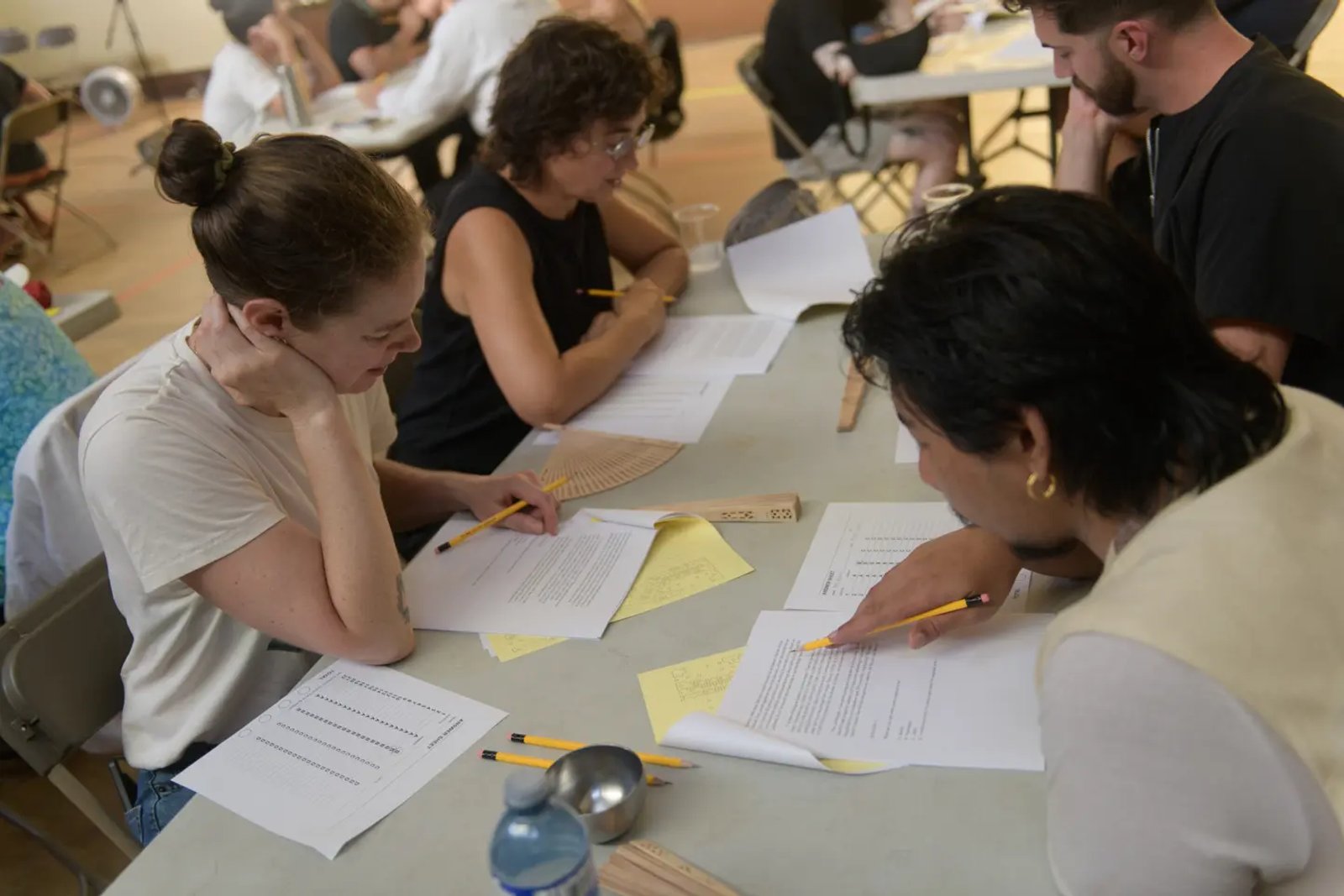
A modern take on Sophocles’ classical tragedy, The Chains invites audiences to question the role they could play in a political society.
La Cité-des-Hospitalières stood gray and solemn on this sunny Thursday afternoon. I entered the room knowing this would be an immersive kind of experience and took my seat at a random table. A modern take on Sophocles’ classical tragedy, The Chains invites audiences to question the role they could play in a political society. We waited around, chatting softly while eating cherries and observing the room curiously, already revealing small bits of our personalities in these encounters with strangers. The play began with a bell and dictated instructions given by the creator himself, Evan Webber: to complete a multiple-choice format test within an appointed, limited amount of time. We were told to read the questions aloud within our groups, and the four of us began reading in unison; it sounded like a chant, and I, being unable to concentrate, suggested that only one of us read. A, C, B, B, D, A. So it went for 22 questions, and I invite you now to partake in my own twist on the matter…
C voters can stare out the closest window and think about death for the next 7 minutes.
1. What’s it like being part of a collective mourning ritual?
- It isn’t like anything
- I was only able to understand it through the post-show talk
- We can say that a suicide is worth mourning over too
- Those left behind need a space to release sadness
2. How different is it to participate in a theatre production as a passive spectator as opposed to an active actor ?
- The process may be different but the outcome is the same
- It makes us question our role in society and in shaping the world around us
- My vulnerability is more at stake
- I didn’t have a choice, so the question of free-will is one worth naming
3. Why Sophocles’ Antigone ?
- Because it’s a Rorschach test
- Where there is political theatre, there is, inevitably, Antigone
- I don’t know and I’m honestly tired of it being the standard
- She sacrificed herself in honour of a proper mourning ritual
If you mostly answered A, you are to read the following passage with a light humorous tone in mind. Those with the most Bs could skip it and continue doomscrolling asmr soap clips on Instagram. C voters can stare out the closest window and think about death for the next 7 minutes. Finally, if D was the most frequently chosen letter, then you skip this next paragraph and redo the test.

Congratulations on making it this far! Now, back to the review. Upon finishing the tests and discovering our personality types, our group was divided into four categories of characters: Antigone, Chorus, Creon, and Later-Antigone. We were then given a set of instructions and began rehearsing for our condensed reenactment of Antigone. The masks we were given smelled like beeswax and obstructed my view. I kept bumping into the same person in my Chorus group. We built a wall with tables and chairs and claimed the end. In conclusion, performer and writer Evan Webber proceeded to lay papers on the floor in such a way that it took the shape of a corpse, he then placed a small flower in a vase at the center of this installation and lay down beside it. We were taught a protest gesture, a human chain structure that we built by standing in a circle and intertwining our arms with one another’s.
It’s difficult to grasp the intent of the creator with so many complex themes being discussed in the piece. However, I know that when it comes to subverting the canon, The Chains delivered. Ritualistic theatre is a genre I am unfamiliar with and was delighted to have experienced for the first time alongside giant wooden hands, the sound of fans, having no clear answer and an upper lip glistening with sweat.
The Chains was presented on Thursday, June 4th, 2026 at the Cité-des-Hospitalières by Festival TransAmériques. For upcoming editions and programming, visit fta.ca
 About Azin
Azin Mohammadi is a librarian, performer, and writer. She was born in 1993 in Iran before moving permanently to Montreal at the age of four. Mohammadi holds a BFA from Concordia University as well as a Master's of Information Studies from Université de Montréal. Her performance and playwriting practices were developed autonomously and alongside different companies, collectives, residencies and festivals locally and internationally.
Read moreComments
No comments yet.
Be the first to speak into the void.