
Уя, and being a witness to it, was a contemplation of what it means to live on this Earth, not pretending it is anything but exactly what it is, and to search for the space where we belong and can finally breathe.
Multiple lives intersect here at Уя (pronounced uia, translated to nest). As do the walls. And all of them are tinted with violence.
The creator of Уя, Chagaldak Zamirbekov, describes the show to be a mix of realistic and hyperrealistic interpretations of his interviews with people from his hometown, when he asked them what home means to them. The show stays true to his word. Long mundane monologues in Kyrgyz and Russian are delivered by unmoving, and sometimes unseen, actors.
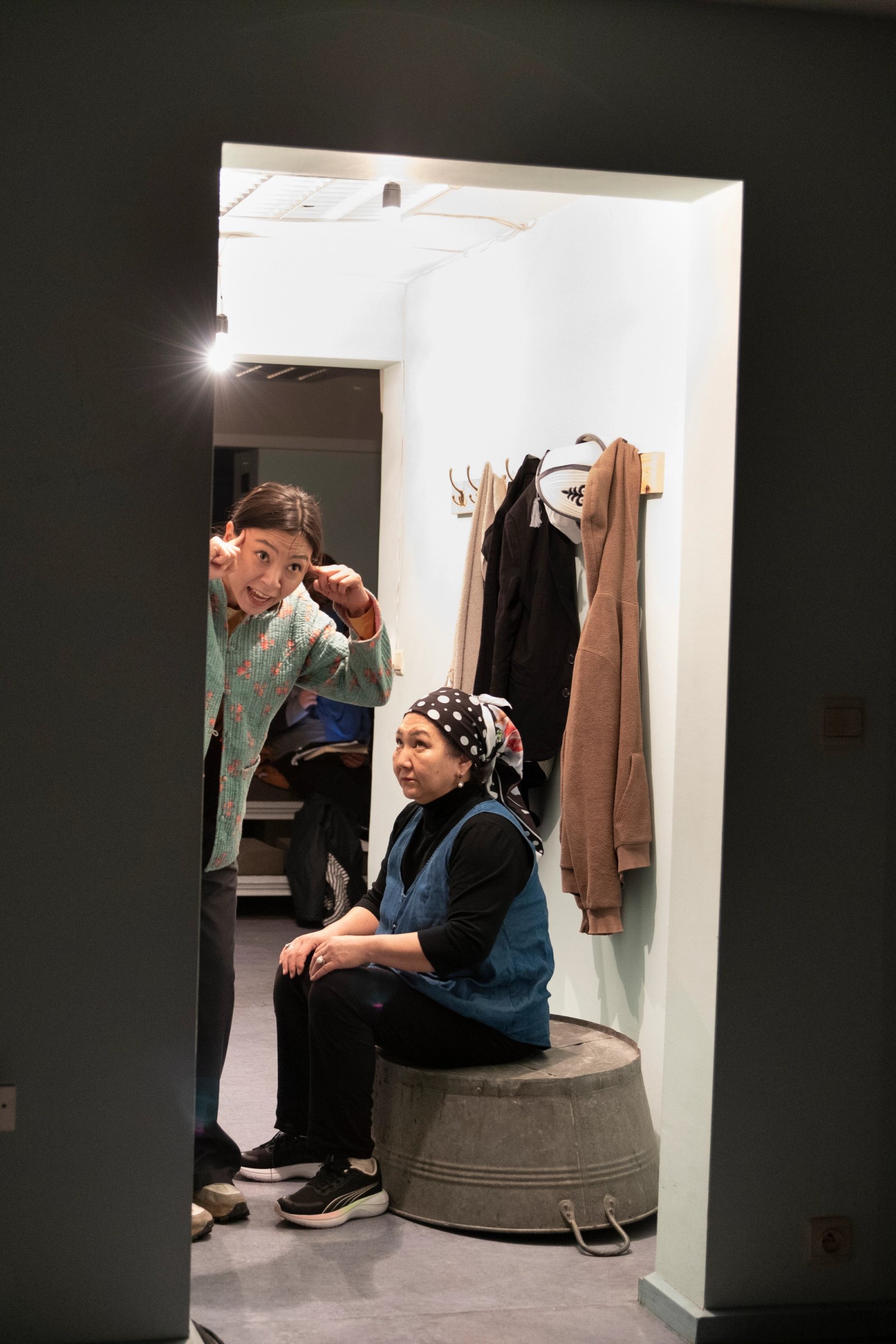
Уя is set in a corridor; we see the whole play from a slant in the wall. While sometimes the actors came into the audience, I would often see only an arm, or the back of a head. Or only hear a voice, or the sound of a body moving.
The monotony of the monologues, the carefully curated undramatic everyday movements, and the limited vision of the stage lets the mind wonder, and zoom in. The actors speak of their childhood, or their father, or their mother, and our bodies slow down to the low volume of their voice and the quiet of the stage as the walls eat all the echo. You look around, read the subtitles for a bit, move your stiff neck around, and then your focus shifts back to the actor. Often, their monologue has moved on to be about war or violence, and you look at their crouched body again, or their eyes full of such passion that it chokes you up, and something changes. They haven't moved, everything on stage is the same, and yet everything has changed. The naked body of actor Emil Zhusupbek uulu is no longer a boy getting washed by his mother. But a man stripped down by the hardships of his life. No dramatic gesture has revealed this change. No tone change indicates this shift. It is in this absence of dramatic entertainment and sensory input, in these moments of ordinary boredom, in this quality of hyperrealism and hyperfocus, that theatricality emerges.
The shift in our understanding and the unexpected emergence of theatricality occurs precisely because the actors don't perform; we have met every single one of the “characters” they embody in our own lives: the nervous mother, the angry daughter, the radicalized son. Hyperrealism gives us an opportunity to see the people on stage as fully human, instead of experiencing them as actors of a play, victims of violence, or “foreigners” on the news. We enter their lives, and suspend our disbelief almost completely at the fact that this is indeed a theatre show, somewhere far away from Bishkek, Kyrgyzstan. The audience shares the task of performance. It is in our decision and willingness to keep looking and keep listening that Уя becomes itself. A condition that is created by the unusual set, the performers’ commitment to hyperrealistic acting, the complete absence of sound design, and the language barrier between the actors and most of the Canadian audience.

Once you make the decision to be immersed and fully enter the world of Уя, you feel the violence. And while it is not always performed, it exists as a defining undercurrent to all that we see on stage. At the heart is, of course, people’s lives as it is entangled with the social and political conditions of Kyrgyzstan. We hear about the specific flavor of Kyrgyz nationalism and misogyny, and get a brief history of political opposition in Kyrgyzstan. Then, we also see actual violence on stage. Salamatova Nurzat is slapped and thrown into a wall, and later choked, by Emil Zhusupbek uulu, the only male performer on stage. The play doesn’t linger on these moments of overt violence though. And it doesn't deem necessary to lecture us about gendered violence, or how the first population to be violently affected by any socio-political turmoil is women. The play moves right past. It reminds us to accept the violence as part of the normal reality of the world we are a part of.
The tension builds. And there is a moment, after lengthy monologues, piercing eyes, slaps and kicks, and war war war, that I finally cry: a karaoke performance of a song I don't know. It’s a liberation, and it’s heartbreaking. There is a pressure that has been present and suffocating everyone from the beginning of the play: from the linguistic divide between the audience and the performers, the unsynced subtitles, and the desperate eyes of Zere Asylbek kyzy when she asks an audience member if she loves her mother, to all the talk about war, political tension, orphanhood, domestic violence, and death and disappearance. And it all finally finds a way out in this full-body release of a karaoke session. The disco lights are blinding. The actors dance and sing and holler, but none smile. The audience members, who are invited on stage to dance, giggle and make faces to their friends. But the actors have their eyes shut, faces grim, and lost in music.
I think of art as an escape. And I can’t help but think of my own life back in my country, where violence is as much part of your daily life as it seems to be in Kyrgyzstan. I think of us not having booze and music in public, and I think of all the loud private dance parties. This is what we need, it occurs to me in the middle of this love song. When there is no way out, when there is no light at the end of the tunnel, when there is violence and poverty, this is what we need: liberation with art. And I cry as I watch the performers, who I now wholeheartedly believe have shared their own life stories with me, try to survive with music.
It is in this absence of dramatic entertainment and sensory input, in these moments of ordinary boredom, in this quality of hyperrealism and hyperfocus, that theatricality emerges.
Close to the end of Уя, Zere Asylbek kyzy switches to English, and delivers a monologue about the war in Ukraine. She speaks about the reporter who said that he is most affected by the victims of the Ukraine war because they are blond with blue eyes, like him. Asylbek turns to us, and delivers a fully dramatic monologue about her fears of bringing a child into this world, where, if a war happens in her region, no one will care because she looks how she does: Asian. This monologue, with its language and style switch, breaks the conventions that Уя has set up for itself, and undermines what it has successfully been doing up to that point: establishing that we are not voyeurs of these lives, but willing guests in a house, a nest, there to listen, participate, and learn. Asylbek implicitly accuses us of leaving her alone in her struggle, drawing a wall between us that wasn’t present during the rest of the play. By this point, close to the end of the two-hour performance, my tears are dry, my emotions exhausted, and my patience low. I wish Asylbek had let me stay in the hypnotic state that was between theatre and reality, spectator and participant, violence and the ongoing force of life.
Уя leaves me feeling strange. I find the whole event difficult to describe. I keep thinking back to it, trying to relive and articulate the corporeal experience of being in that room. As I write, I conclude that Уя, and being a witness to it, was a contemplation of what it means to live on this Earth, not pretending it is anything but exactly what it is, and to search for the space where we belong and can finally breathe.
Уя (Nest) was presented at Espace Libre as part of Festival TransAmériques (FTA)’s 2026 programming from June 5th to June 10th. Уя was the only show presented at the festival’s 2026 programming not from the Americas. For more information about the show check https://fta.ca/en/programme/uia-nid.
 About Banafsheh
Banafsheh Hassani بنفشه حسنی is an Iranian feminist theatre artist based in Montreal. Their passion and belief in the value of cultural criticism and the significance of loud racialized voices led to the creation of DIS in 2026.
Read moreComments
No comments yet.
Be the first to speak into the void.